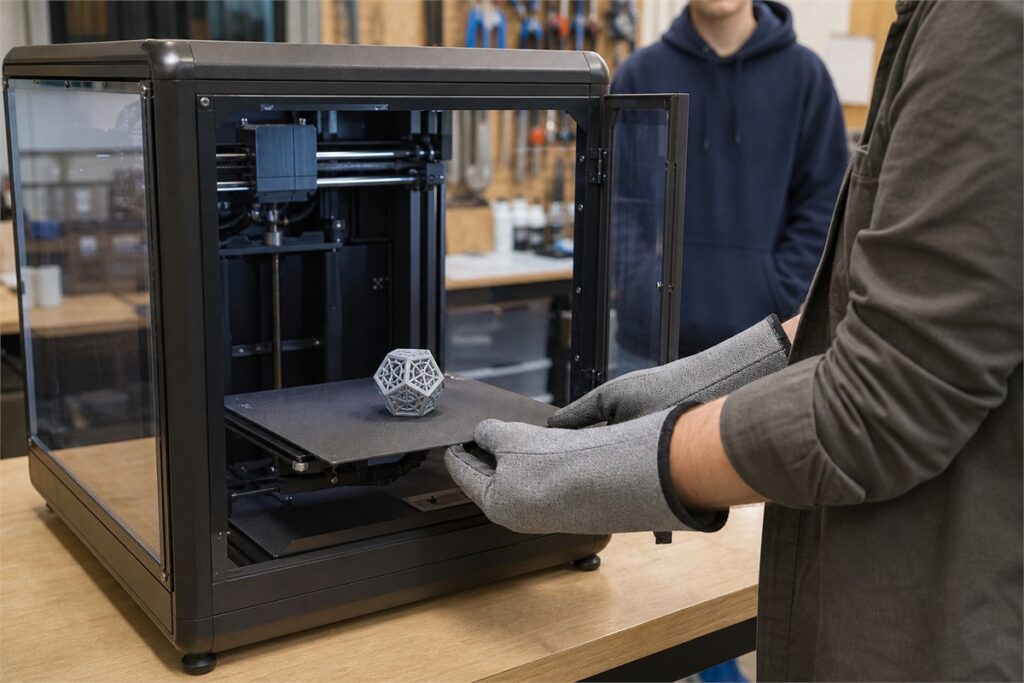
A finished model does not mean a school 3D printer is ready for the next class. The screen may say the job is complete while the build plate is still warm, the enclosure still contains process air, a filament change has not been recorded or a failed edge remains stuck near the nozzle. A useful handoff closes those gaps without turning students into repair technicians.
The NIOSH guide for schools and makerspaces treats 3D-printing safety as a combination of emissions control, equipment choice, work practice and maintenance. That is a better frame than one universal cooldown timer or one cleaning ritual. Different printers and materials have different manufacturer instructions, but every class can leave the next group the same four kinds of evidence: room state, machine state, material state and an explicit decision.
The handoff starts before anyone reaches into the printer
Read the room as part of the machine
Start with the controls that were supposed to be operating during the print. Is the enclosure closed? Is the local exhaust or other approved ventilation path still working as the school procedure requires? Has someone blocked an intake or moved the printer away from its assigned position? These observations belong in the handoff because the printer and the room were working as one system during the job.
This is not a reason to improvise ventilation by opening random ducts or moving a hot printer. It is a reason to compare the room with its approved setup and report a difference. A 2025 NIOSH summary of evaluations in 11 school settings found ultrafine particles and volatile organic compounds during printing and described opportunities to improve engineering and administrative controls. A class note should therefore say whether the expected enclosure or exhaust was in place, not merely that the model looks good.
Separate “print complete” from “safe to handle”
Keep hands outside the build area until the machine has finished its own shutdown or cooldown sequence and the responsible adult has checked the model-specific instructions. A fan that is still running, a plate that still reads warm on the approved interface or a strand of plastic near a moving part is a reason to wait. Do not defeat an interlock, reach past a moving mechanism or use a metal tool to hurry the handoff.
The point is not to invent a temperature that fits every printer. The point is to record the observable state: job ended, motion stopped, normal cooldown completed, plate released only under the school’s procedure. If one of those facts is missing, the next class receives a “wait” state instead of a vague promise that the machine is probably fine.
Leave evidence the next class can act on
Keep the material story attached to the job
Record the filament type and color that actually ran, whether the spool was changed, and whether the print showed lifting, heavy stringing, an unusual odor or a partial stop. Those notes do not diagnose a nozzle, sensor or material problem. They keep the next teacher from repeating the same setup while assuming nothing changed.
A photo of the completed model on the plate can be useful when a corner lifted or a layer shifted, but the image should show the result rather than a student reaching into the machine. If the print failed, leave the failed part with the note until the responsible adult decides whether it should be retained for troubleshooting or discarded. That preserves a clue that sweeping the bench would erase.
Clean only after the decision is clear
The UL Chemical Insights school poster places surface cleaning after the run has finished and the printer has cooled, recommends wet wiping around the printer and calls for HEPA-filtered vacuuming of floors and nearby surfaces. That order matters. Cleanup should not put a hand near heat or motion, and a dry brush should not be used to scatter residue around a shared makerspace.
Follow the printer and material maker’s cleaning instructions for the build plate and nozzle. The class handoff is not permission to scrape, disassemble or apply a solvent because a surface looks untidy. If residue needs a method that is not already in the school procedure, stop at the observation and pass it to the trained adult who owns that maintenance step.
- Ready
- The approved cooldown is complete, the room controls match the setup, the material and result are recorded, and routine cleanup is finished.
- Wait
- The machine is still completing a normal sequence, the plate or enclosure is not ready to handle, or the room condition has not yet returned to the school’s release point.
- Refer
- An unexpected odor, repeated print defect, damaged component, missing control or uncertain cleaning method needs the responsible adult before another job begins.
A good makerspace handoff is short because the categories are clear. It tells the next class what ran, what remains, and who owns the unresolved decision. The 3D printer becomes ready through a known release state, not because the bell rang and the previous group left the room.