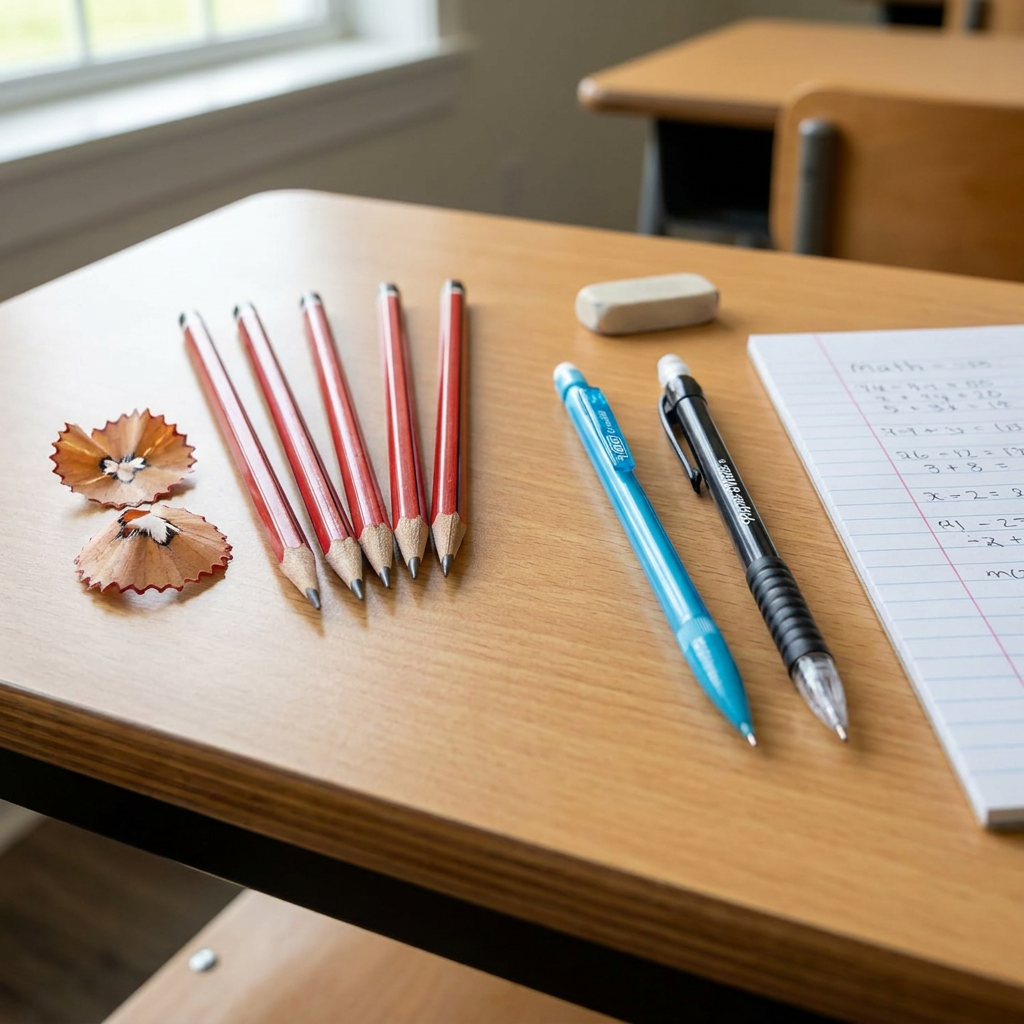
Wood pencils change as they wear and sharpen, while mechanical pencils keep a consistent line (often 0. 7 mm) for steadier control.
That sounds small. In school and daily writing, it isn’t.
Wood pencils and mechanical pencils follow different logic. A wooden pencil is a disposable point that’s constantly being renewed by sharpening. A mechanical pencil is a reusable holder that feeds a thin graphite core forward. They don’t solve exactly the same problem, even though both make a grey line.
For quick orientation, focus on three levers. They decide most outcomes.
- Line consistency: mechanical stays stable; wood shifts as the tip wears and gets reshaped.
- Maintenance: sharpening versus refilling and clearing jams.
- Rules and logistics: many exams still ask for a #2/HB wood pencil.
Wooden pencils vs mechanical: the short answer
Mechanical pencils make sense when consistent line width and quick corrections matter, such as math, diagrams, and neat note-taking. A common school default is 0.7 mm lead, which tolerates more pressure than 0.5 mm before snapping.
Wood pencils fit better when rules require them, when durability matters more than precision, or when younger writers benefit from a thicker shaft and simpler handling. #2 in the US roughly maps to HB on the graphite scale, and that’s still the standard most scan-based tests mention.
Neither format is automatically "better." Each favors a different kind of control: mechanical pencils favor consistency and fine control at the tip, while wood pencils favor robust handling and easy recovery from mistakes by simply sharpening to a fresh point.
What is really being compared in a wood pencil vs mechanical decision?
Most comparisons get stuck on "sharpening versus clicking." That’s the visible part. The practical difference sits deeper, in how the writing point behaves over time.
A wood pencil starts with a shaped cone of wood around a thicker graphite core. As it writes, the point blunts and the contact patch grows. Lines can get broader, and the feel often becomes smoother. Then sharpening resets the geometry. That reset is both a strength and a disruption. It restores precision but costs time, creates shavings, and changes the length and balance of the pencil.
A mechanical pencil keeps the barrel length and balance stable. The lead advances in small increments, so the writing geometry changes more gradually. But the lead itself is thin. That changes how pressure, grip, and paper texture show up in the handwriting.
In classrooms, this comparison often includes hidden constraints that have nothing to do with "preference."
- Test policies: many US standardized tests still specify a #2 pencil in their instructions.
- Desk reality: shared sharpeners, missing sharpeners, broken classroom sharpeners, and time limits.
- Cleanup: wood shavings and graphite dust versus occasional broken lead fragments.
- Replacement rhythm: losing a mechanical pencil can cost more than losing a single wood pencil, but it depends on how often each disappears.
So the real question behind mechanical vs wooden pencils is about predictability under constraints: predictable line, predictable maintenance, predictable compliance with rules.
The performance differences that show up on paper
Writing performance isn’t just "dark" or "light." It’s line width, point stability, smudge tendency, and how much force the hand uses to get a readable mark.
Line width and precision. Mechanical pencils are defined by lead diameter. Common sizes are 0.5 mm, 0.7 mm, and 0.9 mm. A 0.5 mm lead can produce cleaner small lettering but punishes heavy pressure. A 0.7 mm lead is more forgiving for everyday school writing. A 0.9 mm lead starts to behave more like a sturdier point for heavy-handed writers, though it can look chunkier on narrow-ruled paper.
Wood pencils don’t have a single "diameter experience." The core is thicker, but the usable tip depends on how it’s sharpened and how fast it wears. A freshly sharpened wood pencil can be very precise. Ten minutes later, it may be broader. That variability can be helpful for shading and quick writing, and annoying for tight diagrams.
Pressure and fatigue. Mechanical pencils often reveal grip problems because thin lead breaks when force spikes. Some writers respond by gripping harder, which increases fatigue. Others respond by learning lighter pressure, which can improve endurance. Wood pencils tolerate heavier pressure without immediate failure, so they can mask an overly forceful grip for longer.
Smudging and cleanliness. Graphite hardness matters. In the common H/B scale, "B" grades are softer and darker, and they smudge more. "H" grades are harder and lighter, and they smudge less. HB sits in the middle. Many school #2 pencils are close to HB. Mechanical pencil leads are also sold as HB, 2B, and so on, but the thin format can transfer graphite to the side of the hand more easily during fast note-taking.
Eraser reality. Wood pencils often have a larger eraser plug than the small erasers built into many mechanical pencils. That changes how quickly the eraser wears out and how cleanly it lifts graphite. A small eraser can still work fine for short corrections, but it pushes more students toward separate block erasers for longer assignments.
School practicality: rules, maintenance, and reliability patterns
School use is a logistics problem disguised as a writing tool question. Maintenance style matters as much as the line on the page.
Compliance and scan-based testing. In the US, #2 pencils are still the safe default for bubble sheets and many classroom tests. Mechanical pencils can be accepted in some settings, but policies vary by district, teacher, and test provider. When instructions are strict, a standard wood pencil avoids arguments and last-minute scrambling.
Sharpening versus refilling. Sharpening is noisy, creates waste, and depends on access to a sharpener. It’s also extremely robust. A wood pencil with a cracked barrel still writes after sharpening. Refilling mechanical lead is clean and fast when done correctly, but it introduces failure modes: empty barrels, wrong lead diameter, and lead that breaks inside the mechanism.
Common mechanical pencil issues. Three patterns show up again and again in schools.
- Lead breaks repeatedly: often tied to pressing too hard, using 0.5 mm with heavy pressure, or extending too much lead at once.
- Tip wobble or looseness: more noticeable in cheaper models and in pencils that have been dropped.
- Lead jams: crushed lead dust can clog the clutch, especially if the pencil has been dropped tip-first.
Those aren’t defects in the abstract. They’re predictable outcomes of thin graphite in a moving mechanism.
Durability under drops. Wood pencils tolerate falls well. The worst case is a cracked core that breaks during sharpening. Mechanical pencils can survive drops too, but the tip can bend, and internal lead can shatter into short pieces that feed poorly. That’s why some students love mechanical pencils at a desk but avoid them in crowded hallways and backpacks.
The choice isn’t about "old-fashioned versus modern." It’s about which failure mode is easier to live with in a specific school day.
Lead size and grade: how 0.5, 0.7, and 0.9 mm change "control"
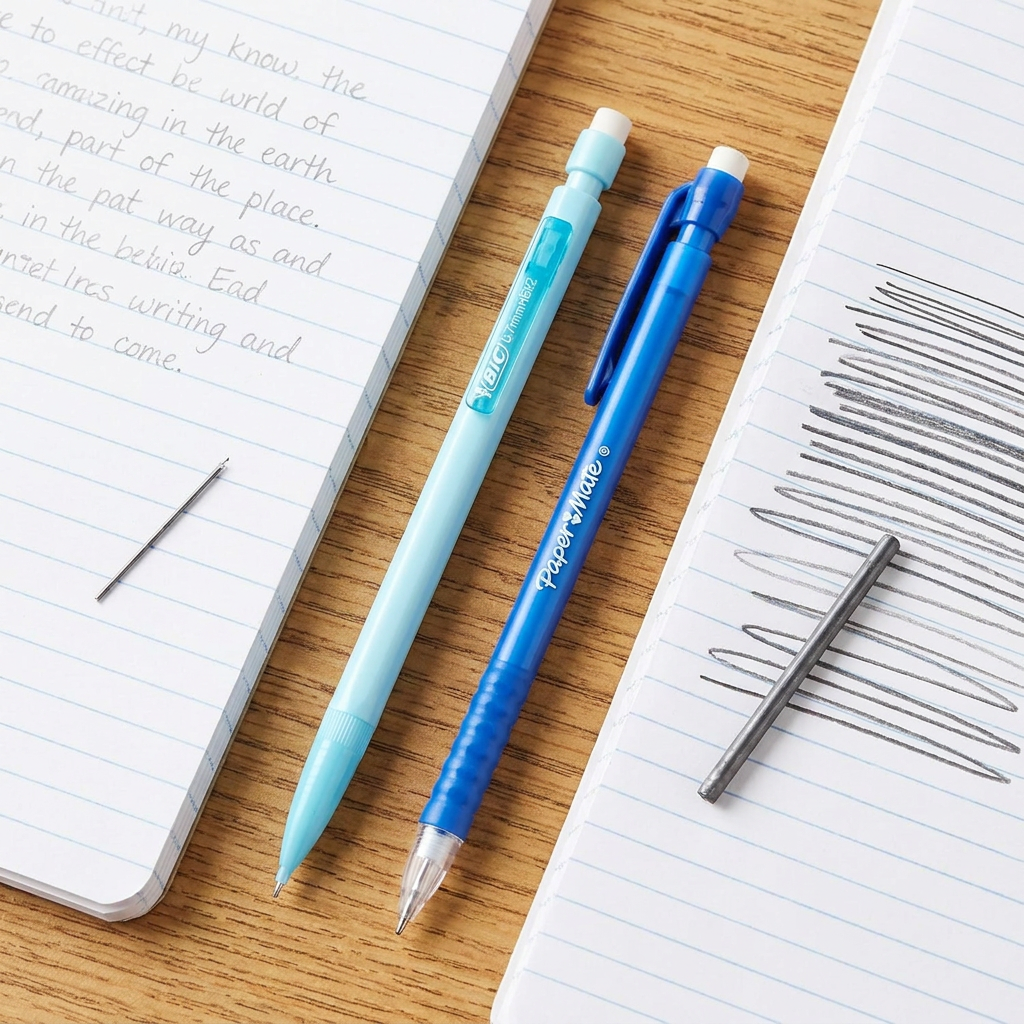
Part of the wood pencil vs mechanical debate gets decided before the first word is written: lead diameter and graphite grade set the failure mode. A 0.5 mm mechanical point rewards light pressure and small letterforms. It also punishes rushed writing on rough paper, because the exposed lead column is thin. A 0.7 mm point sits in the middle for most school notebooks. And 0.9 mm shifts the feel toward sturdier strokes and fewer snaps, but the mark can look heavy on tight ruling.
Diameter isn’t just thickness. It changes how far the lead can extend before it flexes. Keeping extension short matters more on 0.5 mm than on 0.7 mm, and more on 0.7 mm than on 0.9 mm. That single habit separates "mechanical pencils are fussy" from "mechanical pencils are predictable."
Graphite grade adds a second layer. HB is the school middle ground, close to the #2 behavior many teachers expect. 2B goes darker and softer, so it can feel smoother but smudges more and can break easier in thin diameters. H and 2H go lighter and harder, so they resist smudge and point wear, but can feel scratchier on cheap paper and may look too faint under fast scanning or low-contrast photocopies.
- Small math, tight grids, compact planners: 0.5 mm with HB or H rewards precision, but demands lighter pressure.
- General class notes and mixed subjects: 0.7 mm with HB is the least surprising setup across paper types.
- Heavy-handed writers or fast copy work: 0.9 mm with HB reduces breakage, but trades away fine detail.
Wood pencils shift these variables indirectly. A sharpened wood tip can mimic a fine mechanical point for a short window. Then it drifts. Mechanical pencils stay in their lane.
Exam rules and what "#2" really implies in practice
School policies don’t just prefer wood pencils. Many test instructions specify "#2" because the format and darkness are predictable for scan-based scoring. It’s an operational choice tied to optical mark recognition and proctoring simplicity.
"#2" is a US classroom shorthand that roughly maps to HB on the graphite scale. It describes the darkness and hardness band that produces a clear, erasable mark without excessive smudge. Mechanical pencil leads are sold in HB too, but classrooms often treat "mechanical" as a separate category even when the graphite grade matches. Some teachers accept it without a second thought. Some don’t, especially when the test packet instructions are strict.
So the practical question in a mechanical vs wooden pencils decision becomes: how costly is non-compliance on the day it matters? If a student shows up with only a mechanical pencil and the proctor insists on wood, the fix is simple only if spares exist. If the policy is unclear, the safest approach is redundancy, not debate.
For readers who want a neutral reference point on how scan-based tests treat pencil requirements, the College Board’s SAT materials have historically specified a No. 2 pencil for paper testing. Policies evolve, and many assessments have moved digital, but the logic behind "#2" wording hasn’t disappeared. A concrete example is available in College Board’s "What to Bring" guidance.
Mechanical pencils can still fit exam use. They just add a policy check step that wood pencils rarely require.
Hand development and grip: when the format changes the writing behavior
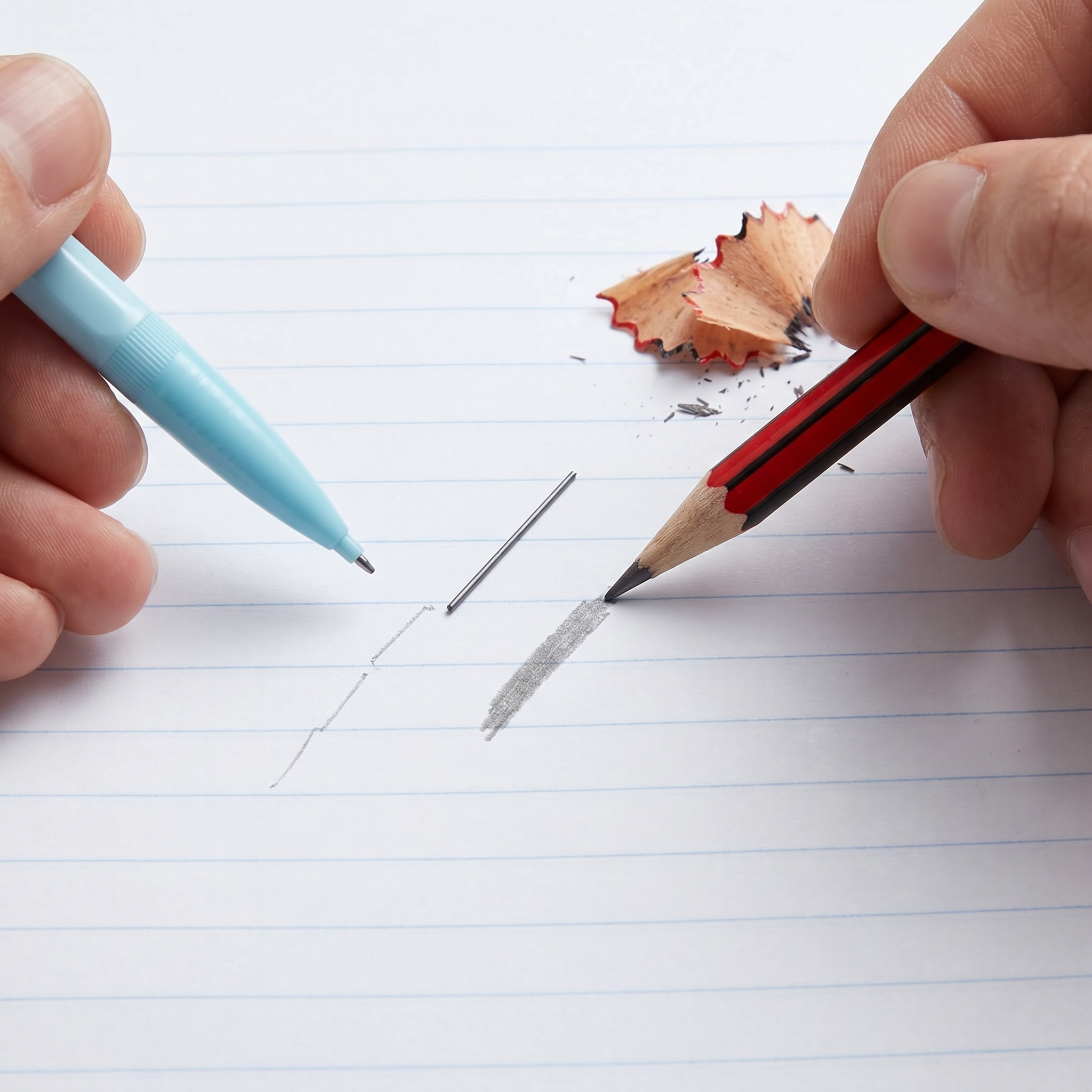
Mechanical pencils and wood pencils ask different things from the hand. Thin lead makes pressure visible. When a student presses hard, breakage becomes feedback. That feedback can be useful. It can also trigger a counterproductive response: tighter grip, more tension, and even more pressure spikes.
Younger writers often do better with thicker barrels, shorter length, and a grip that doesn’t force fingertip precision. Many standard wood pencils naturally provide more diameter than slim mechanical barrels. Jumbo wood pencils go further. They reduce the fine-motor demand and can make tripod grasp easier to establish. A thin mechanical pencil can still work for kids, but it tends to be smoother when paired with a wider grip sleeve and with lead that tolerates pressure (often 0.7 mm or 0.9 mm).
Point consistency also changes how letters are formed. With a wood pencil, the gradual blunting can encourage broader strokes and less needle-point correction. With a mechanical pencil, the stable line can invite tiny adjustments and overwriting. That can improve neatness for some students. For others, it turns into slow writing and more erasing.
Time matters here. Over a 30–45 minute writing block, small inefficiencies compound. A student who stops repeatedly to manage lead extension, rotate the pencil to avoid a flat spot, or chase broken pieces inside the tip loses more time than the tool choice suggests on paper.
- Students building basic handwriting fluency: thicker shafts and simpler recovery (sharpen and continue) often reduce friction.
- Students with strong fine-motor control: consistent mechanical points can support small, tidy lettering.
- Students with high pressure or fatigue: sturdier diameters and softer grip surfaces often matter more than format.
This isn’t a diagnosis discussion. It’s a usability observation. Format changes behavior.
Reliability under real handling: preventing jams, wobble, and "mystery breakage"
Mechanical pencil problems in school settings usually look random. They aren’t. Most come from three repeatable triggers: drops, over-extension, and mismatched lead diameter.
Drops matter because thin lead shatters internally. Even if the tip looks fine, short fragments can lodge in the clutch. Clicking then advances nothing, or it advances unevenly. Clearing it is possible, but it requires attention and sometimes a cleaning pin. Wood pencils don’t have that internal pathway, so a drop tends to be a surface event unless the core cracks.
Over-extension is the quiet culprit. Extending 5–6 mm of lead invites flex and snap during fast writing. Keeping the lead closer to 1–2 mm reduces breakage sharply, especially on 0.5 mm. That single habit also reduces graphite dust inside the mechanism, which lowers jam risk over time.
Diameter mismatches are common in shared classrooms. A 0.7 mm lead won’t feed correctly in a 0.5 mm pencil, and forcing it can damage the clutch. The reverse (0.5 mm lead in a 0.7 mm pencil) can slide, buckle, and create debris. Wood pencils avoid that entire category of error. They still have their own friction points, but it’s not invisible internal compatibility.
Tip wobble sits in a different bucket. Some wobble is a tolerance issue in cheaper mechanisms. Some is damage. Once a metal tip bends, the pencil may still write, but precise work becomes harder because the point no longer tracks straight. A wood pencil can also get misshapen, yet sharpening resets the tip alignment without relying on a metal tube.
For a wood pencil vs mechanical decision in crowded backpacks, this reliability profile often matters more than line aesthetics. Mechanical pencils can be very consistent at a desk. In high-movement school days, robustness becomes its own form of control.
How to choose wood pencil vs mechanical by task
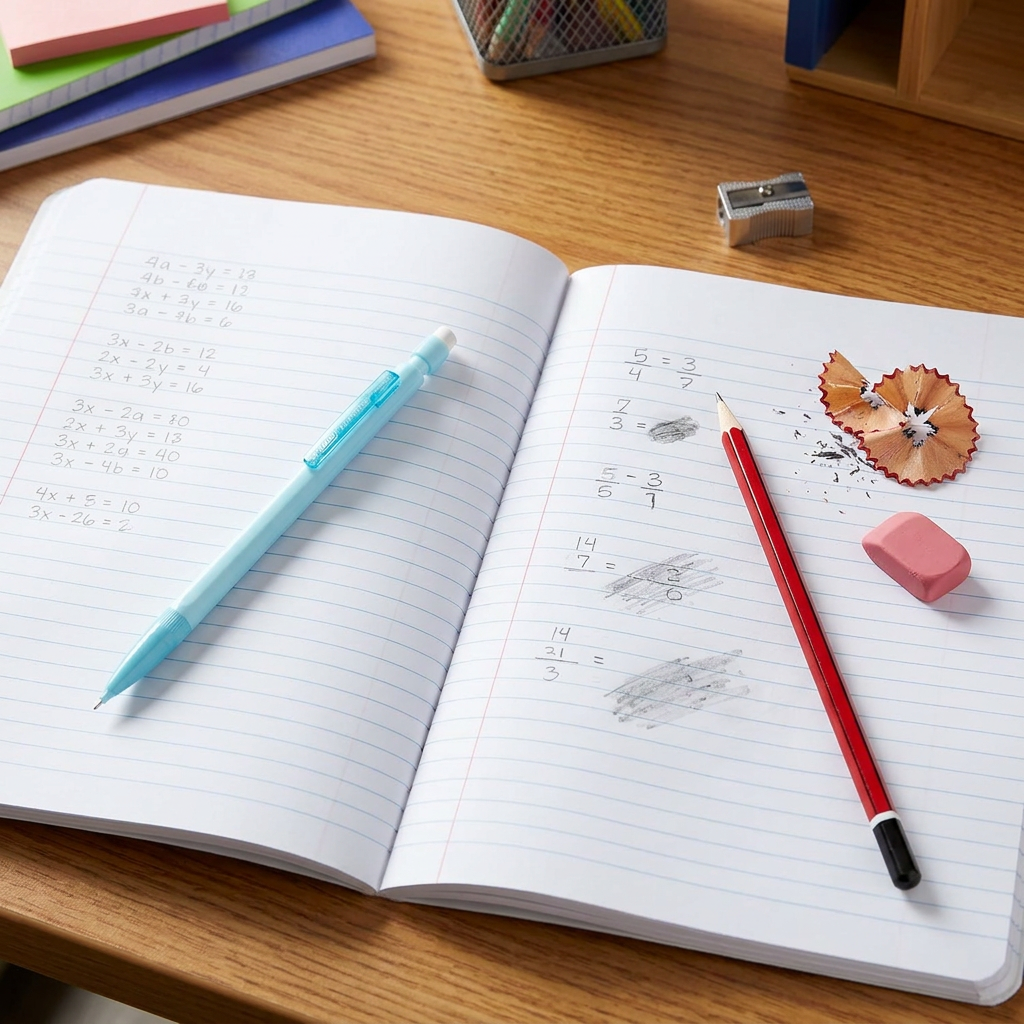
In a wood pencil vs mechanical decision, the choice gets clearer when you think about the most likely kind of mistake. In work with lots of small figures (algebra, chemistry, physics), the common error is "I shifted a box" or "my digits ran together." A consistent mechanical point helps keep size and alignment steady. In tasks where the common error is "I need to redo this fast," a wood pencil tolerates more aggressive erasing, and the emergency reset is simple: sharpen and keep going.
For long writing, fast notes, and classes where you’re writing while standing or moving, precision matters less than rhythm. Wood pencils handle pockets and backpacks without asking for attention. A mechanical pencil can still work well, but it needs one habit: don’t extend too much lead, and don’t treat it like a ballpoint.
For school drawing and quick sketches, the deciding factor is often shading control. A wood pencil lets you vary the stroke by rotating the barrel and letting the point flatten. A mechanical pencil feels more constant and can be rigid for broad gradients, but it’s great for clean lines and small details. In practice, "mechanical vs wooden pencil for drawing" rarely has a single yes-or-no answer. It depends on the technique you want on that page.
Paper is the last filter, and it matters. On rough or low-quality paper, thin lead can catch and snap. On smoother paper, the benefit of a consistent line shows up right away.
When each format fits, and when it gets in the way
This comparison fits students who switch between subjects that involve small writing, diagrams, grids, or frequent corrections, and who want a stable line without stopping to sharpen. It also fits students who care about visual order in notes, or who lose time when class is tight and small maintenance pauses add up.
It gets in the way for students who lose supplies often, write with high pressure and don’t want to change that habit, or deal with strict rules that require a wood "#2/HB" pencil with no debate. It can also become impractical in environments that punish mechanisms: frequent drops, overstuffed backpacks, or constant borrowing between classmates.
Two common classroom mechanical pencils: where they work best and where they create more work
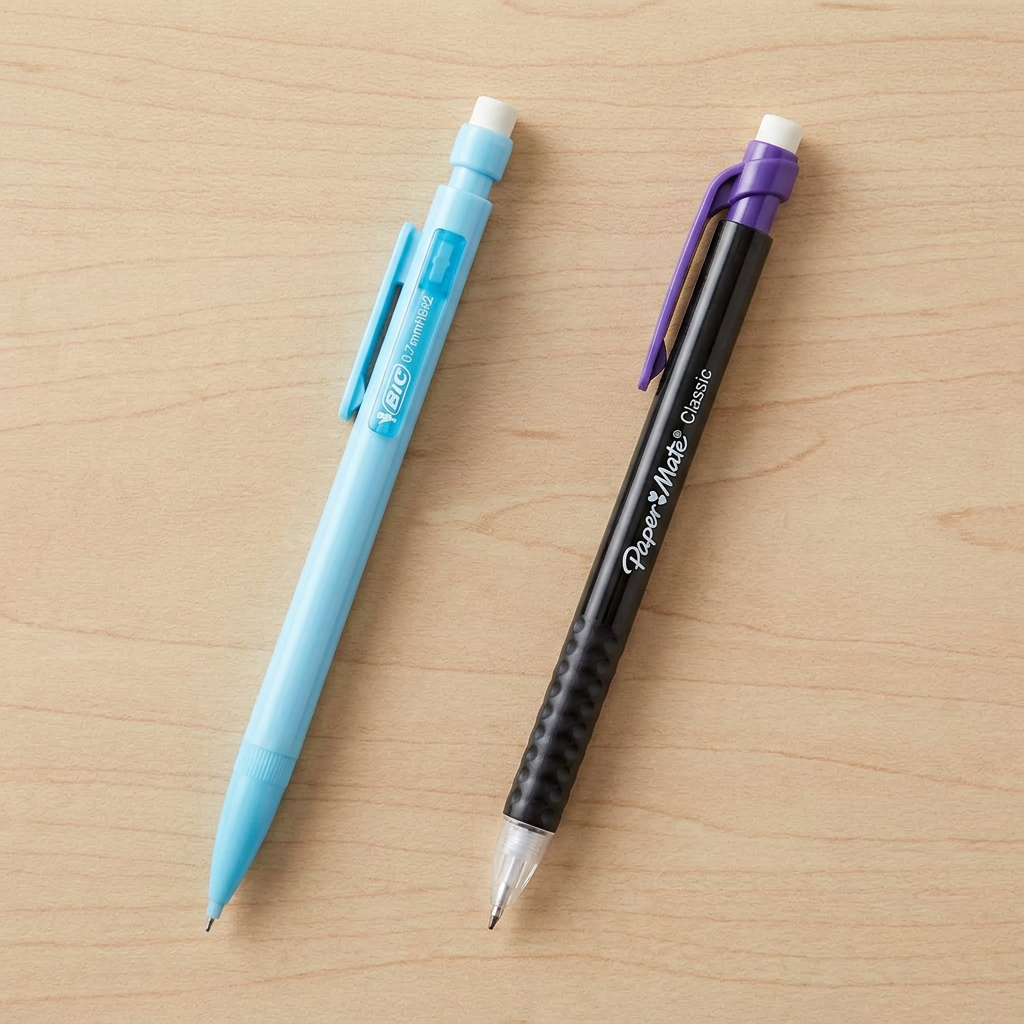
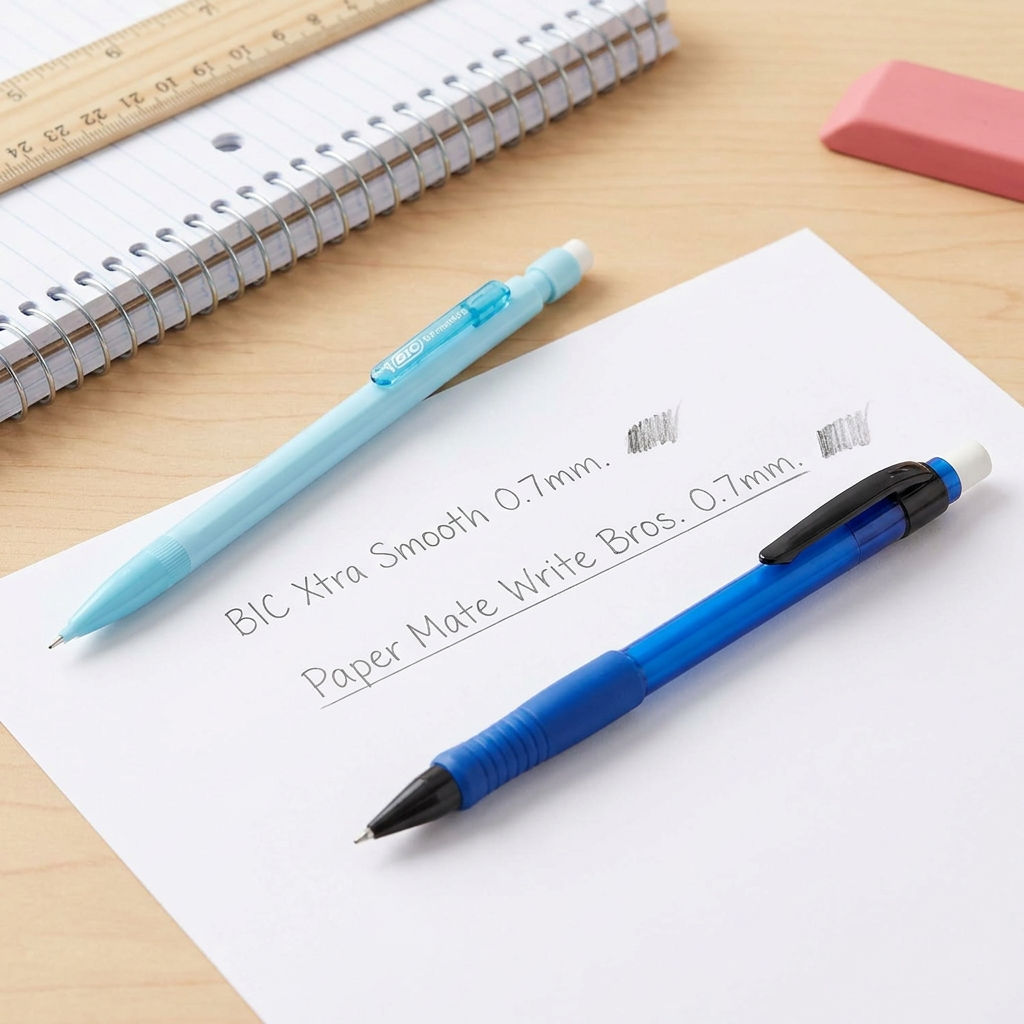
When "wood or mechanical" turns into a concrete purchase, two needs show up a lot: having several identical pencils for class, or having a model that feels familiar for tests and bubble sheets. In that lane, BIC Xtra-Smooth Pastel Mechanical Pencils and Paper Mate Mechanical Pencils, Write Bros. Classic Number 2 Pencil are representative examples of school-focused 0.7 mm mechanical pencils with built-in erasers.
Both tend to work well for routine use because 0.7 mm usually tolerates more pressure than 0.5 mm and asks for less delicacy while writing. But the typical problems don’t change by brand. If the lead is extended too far, if the pencil is dropped tip-first, or if the wrong lead diameter gets used, the experience degrades fast.
One practical note: in classrooms where supplies get shared, mechanical pencils can suffer from compatibility issues and mixed lead sizes. Wood pencils don’t.
Common questions
Are mechanical pencils allowed on exams the same way wood pencils are?
It depends on the exam rules and the teacher, not the line quality. When instructions say "#2" or "HB," a wood pencil avoids arguments. If mechanical pencils are allowed, bring a backup in case the rule gets enforced differently that day.
Which lead breaks less, 0.5 or 0.7 mm?
In fast school writing, 0.7 mm usually breaks less when pressure is high or paper is rough. 0.5 mm works well with light pressure and small handwriting. Lead extension matters as much as diameter.
Why does lead break "for no reason" in a mechanical pencil?
The common cause is extending too much lead, more than the tip needs for support. Drops can also fracture lead inside the barrel, and rough paper can catch the graphite. Keeping the extension short changes the experience a lot.
In a wood pencil vs mechanical choice, which one helps you write faster in class?
For steady writing, a mechanical pencil saves sharpening stops and keeps line width consistent. For chaotic writing with bumps and constant movement, a wood pencil keeps the flow because it tolerates rough handling. Real speed comes from the day’s logistics, not just the point.
- Mechanical pencils reward small habits: short lead extension and the correct diameter.
- Wood pencils pay you back with robustness and simplicity, but the line changes and sharpening interrupts.
- For strict "#2/HB" rules, bring wood pencils even if you prefer mechanical.
- For small math and diagrams, 0.7 mm HB is the least surprising setup.