A class set of safety goggles can look ready while several pairs are still wrong for the people wearing them. A loose strap lets the frame drift when a student turns toward a partner. A bridge that presses too hard becomes a reason to lift the goggles during the activity. A frame that sits on top of prescription glasses can move both pieces at once.
The useful check happens before materials reach the bench. The American Chemical Society’s student laboratory safety guidance says chemical safety goggles belong on everyone in the laboratory, including visitors. That makes fit part of the opening routine, not a correction made after the experiment has started.
The question is not simply whether the room owns goggles
Protective eyewear only helps when its design matches the activity and it stays in the intended position. For a chemistry task with a splash risk, ordinary fashion glasses are not a substitute for chemical-splash goggles. For a different task, the hazard assessment may point to another form of protection. The teacher should settle that equipment choice while planning the lesson; the fit check confirms that the chosen pair works on this student.
Begin with the frame at rest. It should sit evenly around the eyes, without one side riding higher. The seal area should meet the brow and cheek area without a visible gap large enough for the frame to wobble. The nose bridge should not carry the whole load. The strap should lie flat behind the head rather than folding, twisting or catching on a hood.
Watch the frame during a slow head turn
Ask the student to look left, right, down toward the bench and back to the teacher. This is not a dramatic shake test. It is a calm movement that reveals whether the goggles slide, tilt or pull away from one side of the face. The teacher watches the frame and strap instead of relying on the student’s first answer that the pair “feels fine.”
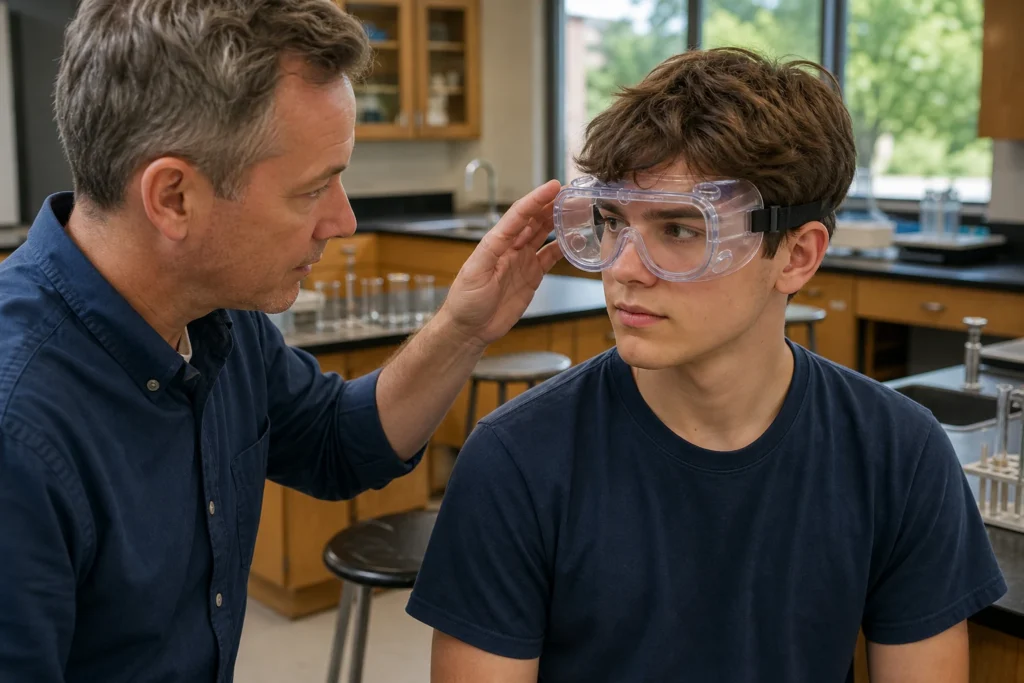
The fit shown in the article image supports this exact moment: the student has turned slightly while the teacher checks the side of the frame and the strap path. If the frame moves with every turn, shorten the strap or try another size. If the lens edge blocks side vision, the pair may be too narrow or sitting in the wrong place.
The physical fit language in OSHA’s eye and face protection standard is a useful observation guide: protection should fit snugly, remain reasonably comfortable and avoid interfering with movement. Those checks are more useful than asking only whether the strap feels tight. Tightness alone can produce pressure without producing stable coverage.
What a stable pair looks like
A stable pair remains centered after the head turn, the strap stays flat, and the student can look toward the edges of the work area without lifting the chin. The lenses should be clear enough to see the bench and the teacher’s demonstration. Hair should not be trapped under the seal in a way that leaves the frame perched away from the face.
Prescription glasses need space, not pressure
Students who wear prescription glasses need goggles designed to sit over them without forcing the glasses out of position. The goggle frame should clear the temples and lens corners. When the student turns their head, both pieces should remain stable; the strap must not push the spectacle arms painfully into the side of the head.
OSHA’s protective-equipment assessment includes goggles that fit comfortably over corrective eyeglasses without disturbing their alignment. In a school lab, the practical response to a poor over-glasses fit is to offer another compatible size or design before the activity begins. Telling the student to remove needed prescription glasses is not a fit solution.
Fogging is information, not permission to lift the frame
Some fogging clears after the goggles settle; persistent fogging may point to poor ventilation, a mismatched size or a warm, damp pair taken straight from storage. Let the student wear the pair for a short moment while still away from the experiment. If vision quickly becomes unreliable, exchange the pair rather than accepting a routine of lifting the frame to see.
Cleaning also belongs before class. Lenses with dried residue, deep scratches or cloudy patches can defeat an otherwise good fit by making students peer over or around them. Follow the goggle manufacturer’s care instructions and the school’s hygiene procedure. A frame that is cracked, a strap that no longer holds tension, or a lens that will not clear should leave the usable set until it is repaired or replaced.
Make the exchange easy
Fit checks work when a student can say “this pair pinches” without delaying the room. Keep alternative sizes or over-glasses models where the class set is issued, not in a distant storeroom. A simple exchange before equipment is distributed is faster than stopping an active lab because a student cannot see or keeps adjusting the goggles.
Release the class only after the fit survives movement
The final decision is observable. The correct type of protection is on the student, the frame stays centered during a slow head turn, the strap remains flat, prescription glasses are not displaced, and the student can see the bench and the edges of the working area. If any one of those conditions fails, change the fit before the lesson moves on.
This brief routine does more than confirm that goggles are present. It removes the predictable reasons students touch, lift or abandon them during the experiment. A usable class set is not a box of identical frames; it is a set that can be matched to the people and the task in front of them.