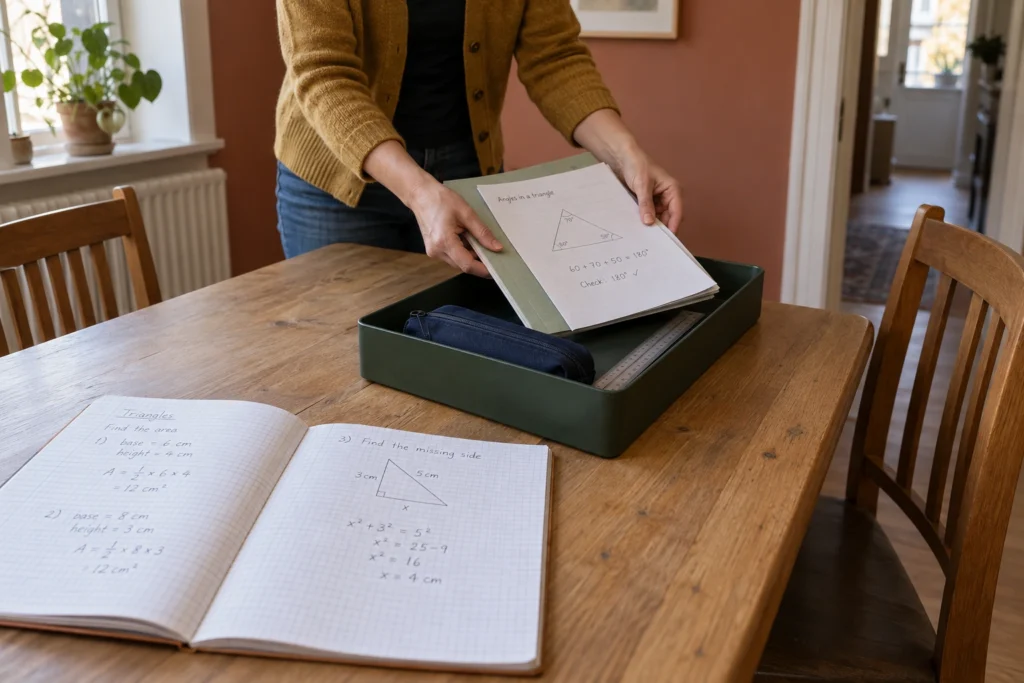
Dinner is nearly ready, but the geometry exercise is not. A notebook, ruler and half-finished drawing occupy the same table that needs to become a place to eat. Piling everything onto the nearest chair clears the surface and creates tomorrow’s search.
A shared homework table works better when unfinished work has a nearby place to wait. Start with what must survive the move: the right page, the loose sheet and a clear indication of where to continue. That is a smaller, more useful storage problem than finding somewhere for every school supply in the house.
Keep the current task together
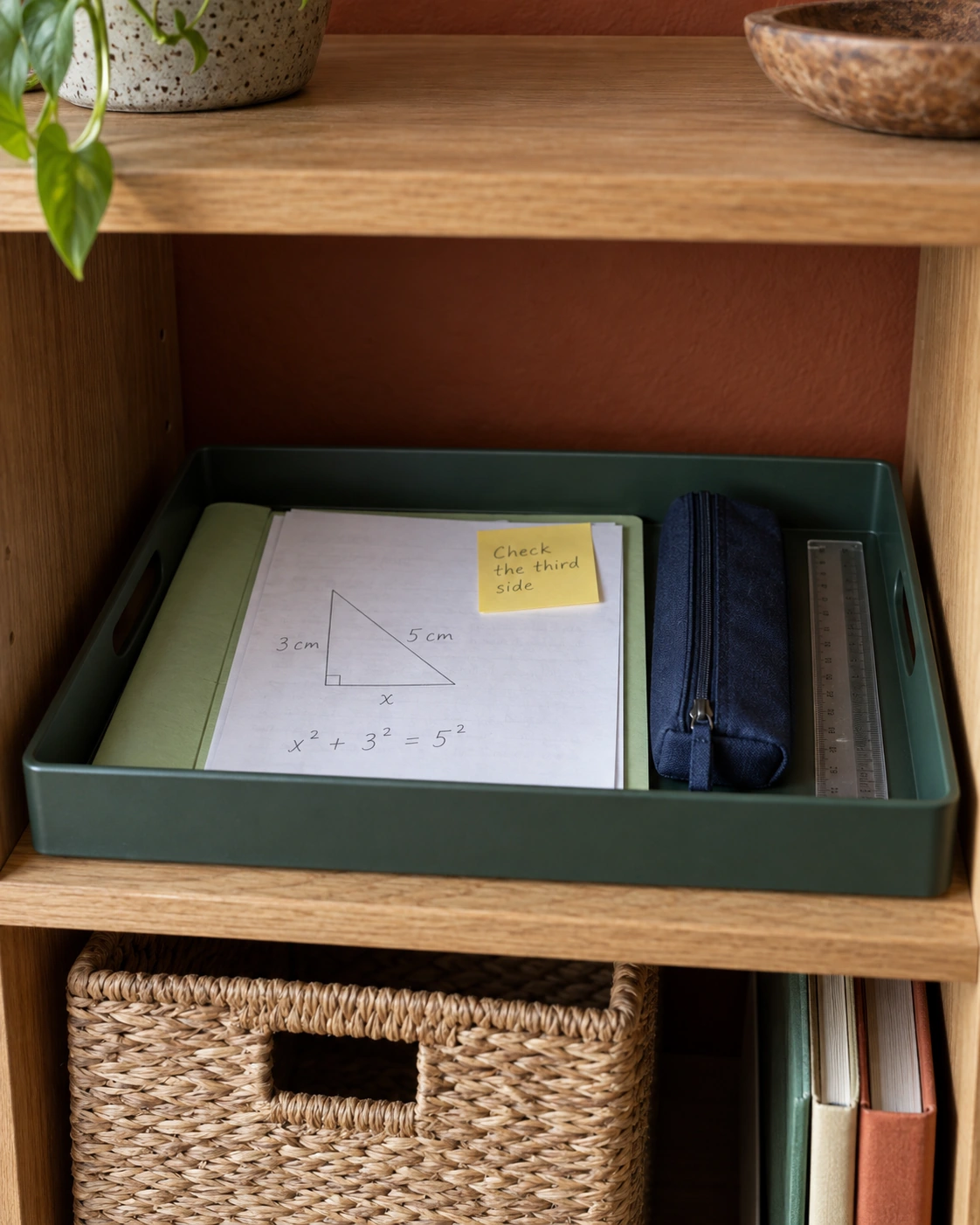
Try a shallow tray with the actual materials before buying more furniture. An exercise book should lie flat; a worksheet should not curl against the sides. A folder can hold loose pages, while a pencil case contains the few tools needed for this assignment. Leave wet paint or glue where it can dry safely instead of stacking another book over it.
Give the three kinds of school material different destinations:
- Work to take tomorrow goes into the school bag once it is ready.
- Unfinished work stays together in its tray or folder, with the next step marked.
- Spare paper, unopened supplies and finished projects live elsewhere.
For two children sharing the table, two identifiable trays are usually easier to return than one deep communal box. Each child can put away a task without moving the other’s papers. Keep the system small enough that the tray can be lifted comfortably when full; a handle does not make an overloaded container manageable.
Consider a maths exercise left halfway through. Keep the drawing with its workbook and use a removable note beside the next question. A brief reminder such as “check the third side” records an action, not a judgement about whether the work is good. Tomorrow, the pupil can put the tray on the table, open the correct page and resume.
Fit the storage around the return journey
Now measure the filled tray and the space where it will wait. A cabinet’s outside width does not tell you whether the tray will pass its door or sit between its internal supports. Check usable shelf width, depth and height, including the space needed to grasp the tray. If those measurements are missing, ask for them before ordering.
For a household buying in Germany, the storage ranges listed through HOMCOM provide one starting point for comparing furniture. Compare the particular unit’s internal space, shelf limits and assembly instructions with the tray you already use. A room photograph is not evidence that your workbook will fit, and household storage should not be assumed suitable for a busy classroom.
Test the movement as well as the footprint. Pull the dining chair back, open the cupboard door and carry the loaded tray between them. A narrow gap that works while everything is closed may disappear at precisely the moment it is needed. Keep the route clear rather than putting the tray on the floor beside someone’s feet.
Follow the furniture maker’s wall-fixing instructions. The CPSC’s Anchor It guidance recommends securing furniture with doors, drawers and shelves against tip-over. A low unit is not a reason to omit a required restraint; use fixings appropriate to the wall and get competent help where needed.
Storage solves only the clearing-away part of a shared workspace. The separate guide to choosing a chair for studying addresses the seat used while the work is happening. Keep both decisions tied to the person and the room.
At the end of the next homework session, notice what still gets left behind. A loose worksheet needs a folder; a forgotten next step needs a short note. Adjust that small failure before adding another cupboard. The table can be ready for dinner while the unfinished task remains ready for tomorrow.