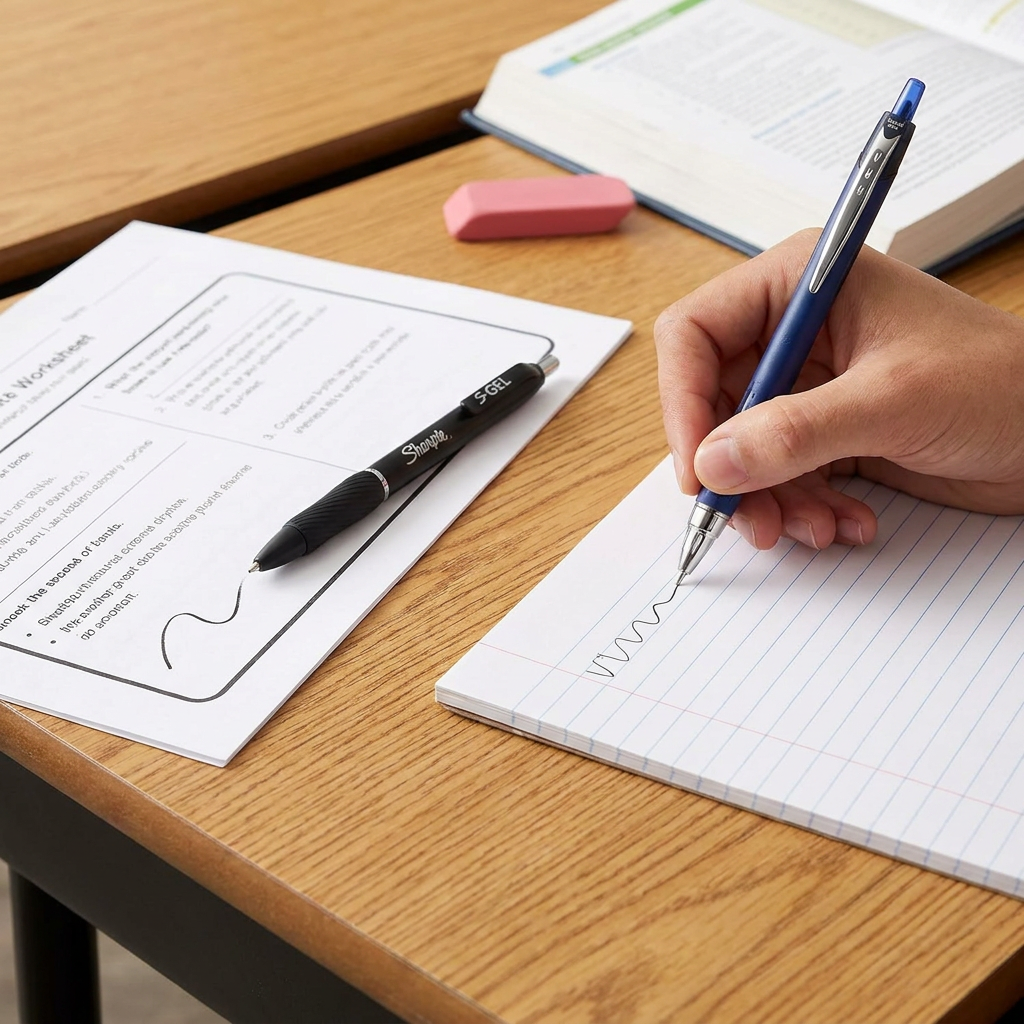
Liquid gel pens write smoother and darker with less pressure, while ballpoints feel more controlled and tend to smear less on cheap school paper.
Liquid gel pen vs ballpoint: what really changes while you write
The choice isn’t about "better or worse." It’s about how the pen behaves in your hand and, more importantly, what kinds of mistakes it tends to create. With a liquid gel pen, you usually get a full line with very little pressure. With a ballpoint, the line is typically drier and often more stable on low-quality paper. In quizzes, narrow-ruled notebooks, and printed worksheets, those differences stop being theoretical.
Compare products: Sharpie S-Gel Gel Pens, Black Barrel, Medium Point (0.7mm), Black Gel Ink, 12 Count · Uni-Ball Jetstream RT Pens – Pack of 3 Black Fine Point Pens, 0.7mm
In practice:
- For fast note-taking: liquid gel reduces hand fatigue, but asks you to respect drying time.
- For tests and forms: ballpoint is less likely to smear, especially with humid hands or smoother paper.
- For backpack and pencil case life: ballpoint usually tolerates bumps and temperature changes better; gel needs a bit more care.
One key point people mix up: "gel" doesn’t always mean "liquid gel." Standard gel is already smoother than a classic ballpoint, but liquid gel pushes even further toward effortless glide. The result is writing that starts quickly and fills in well, but it can spread more on porous paper and it can leave marks if you run your finger over it right away.
When people say "gel pen ink vs ballpoint ink," the practical difference is that gel inks are generally formulated to flow more freely, while ballpoint inks are typically thicker and feel drier on the page. That’s why the same writing speed can look more saturated with gel and more restrained with ballpoint.
What a liquid gel pen is (and where gel ends and rollerball starts)
Liquid gel is a family of gel pens designed to write with less resistance. It isn’t one single official category—brands use different labels—but the idea is consistent: the ink is more free-flowing than many "classic" gels, so the tip needs less pressure to stay consistent. That can reduce tiny skips during fast note-taking and make long writing sessions easier on your grip.
The boundary with rollerball is thin, and it’s worth clarifying so you don’t buy "by vibe" and then get surprised. Rollerballs typically feel even "wetter" on the page. Liquid gel often sits in between: smoother and more saturated than many standard gels, but not as wet as some rollerballs. In real school use, the difference shows up most in two places: drying behavior and how it reacts to a highlighter.
There’s also a third category that complicates the comparison: the hybrid ballpoint. It’s still a ballpoint mechanically, but it’s designed to feel smoother than a traditional ballpoint. If you want a "nearly gel" feel without giving up ballpoint reliability, this middle option is often the real alternative—not gel vs a classic ballpoint at its driest.
A simple way to orient yourself without overthinking labels:
- If the line looks very saturated and uniform with light pressure, you’re in gel territory (often liquid gel).
- If a full line needs a touch more pressure and the stroke feels drier, you’re in ballpoint territory.
- If it feels extremely wet and the paper seems to "soak" quickly, you’re closer to rollerball behavior.
School paper, drying, smudging: the problems that actually decide
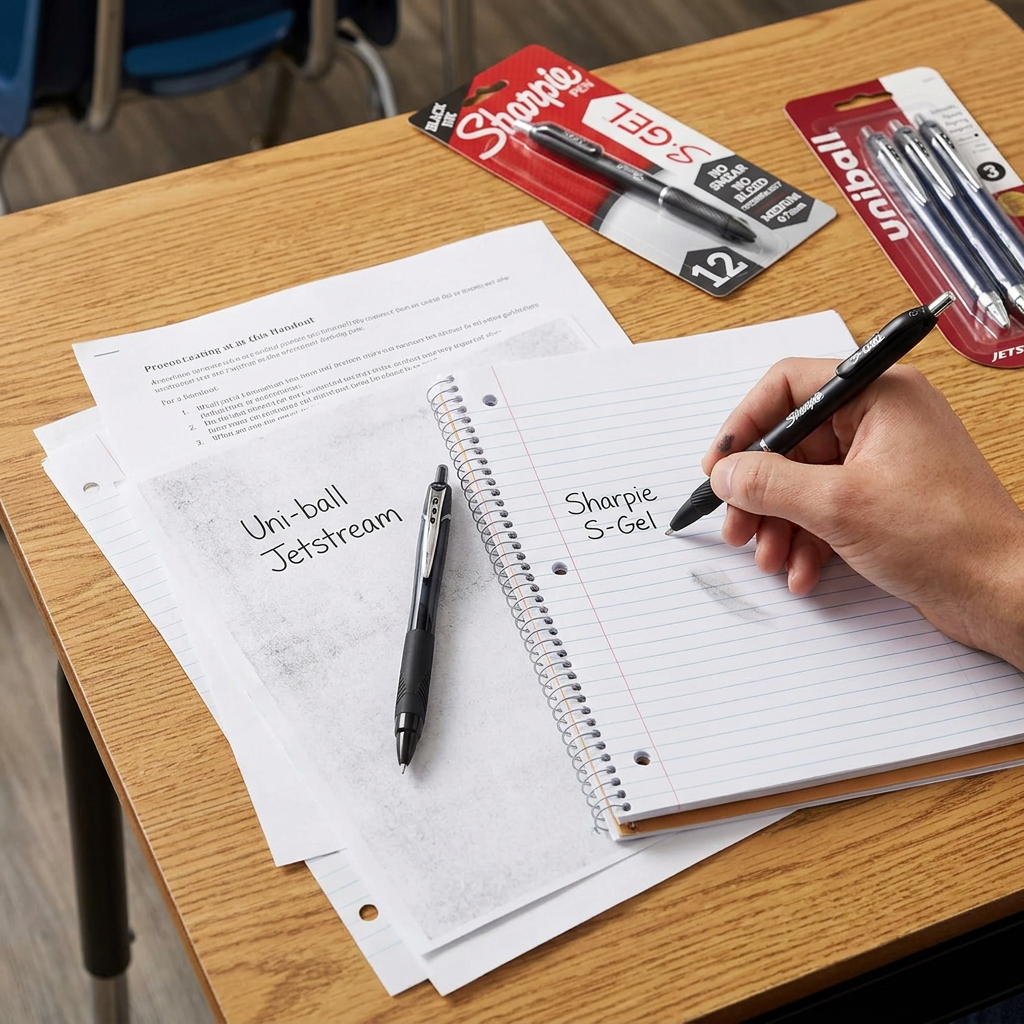
The liquid gel pen vs ballpoint question gets interesting when you bring in real paper: budget notebooks, photocopies, printed handouts, loose-leaf. The question isn’t "does it write well?" but "does it write well on this surface, at this speed, with my hand?"
With gel (especially liquid gel), the classic failure mode is smear from drag. It shows up in three common situations: your hand passes over a fresh line, you write tightly packed notes, or you’re on smoother/slightly coated paper (some photocopies and certain worksheets). Ballpoint usually reduces that risk because it tends to leave less "mobile" ink on the surface.
On the other side, ballpoint’s typical failure mode is a line that gets lighter when you write very fast or at awkward angles—like on a tiny desk or with the notebook tilted. Thicker ink can need a small, steady pressure; if your pressure drops, the line can skip. In math work or quick corrections, that skip can be annoying because it breaks small symbols and marks.
Tip size matters more than people admit. A 0.7 mm tip is a common everyday compromise, but on very absorbent paper a 0.7 liquid gel can spread and make letters look "puffier." A 0.7 ballpoint tends to stay more defined. Moving down toward 0.5 mm generally increases precision and reduces how much ink hits the page; you may lose some of that soft, cushioned feel—especially with gel.
Highlighters deserve their own reality check. The practical question isn’t "does it work with a highlighter?" but what happens if you highlight after a short pause versus after a longer pause. With liquid gel, the risk is dragging ink and dirtying the highlighter tip if you go too soon. With ballpoint, you can often highlight earlier, but it’s not guaranteed—some ballpoint inks can still shift, just differently. The simple rule still holds: the more saturated and glossy the line looks, the more it pays to wait.
As for water resistance, there isn’t one universal answer across all gels or all ballpoints. If a pen doesn’t clearly state how its ink behaves, it’s reasonable to assume that very free-flowing gel inks can be less forgiving of immediate water contact than a drier ballpoint line. If your notes need to survive a leaky bottle in a backpack, that difference can matter.
Everyday reliability: skipping, hard starts, leaks in a backpack
No ballpoint vs gel comparison is complete without reliability, because writing well once isn’t enough. At school, pens live in crushed pencil cases, jacket pockets, and get borrowed constantly. The failure patterns are pretty recognizable.
Liquid gel prioritizes flow. That brings real benefits (easy starts, low pressure), but it can be more sensitive to a few everyday conditions: paper fibers collecting at the tip, leaving the cap off too long, and heat. You don’t need extreme scenarios—an overstuffed case near a sunny window, or a pen left in a warm car, can change how it behaves. Ballpoints, with thicker ink, often tolerate those common abuses better.
Ballpoints aren’t invincible either. Hard starts can show up after repeated bumps or when the ball doesn’t rotate smoothly because of tiny residues. The symptom is familiar: you scribble on the side to get it going again. Gel tends to do this less often, but when it does, it can feel more frustrating because you expect instant smoothness.
For left-handed writers, the difference can get bigger—not as a stereotype, but because of geometry. Many left-handed grips drag across fresh writing more easily. In that case, ballpoint can be more forgiving. Liquid gel can still work, but it rewards attention to page angle, writing speed, and giving the ink a moment before closing the notebook or turning the page.
Two practical signals tell you if your pen choice is fighting your real routine:
- If you get smudges or ink on the side of your hand, drying behavior is your bottleneck.
- If small symbols look broken or "grainy," the tip/ink combination isn’t keeping up with your speed.
- If thin pages show heavy shadowing on the back, you’re laying down too much ink for that paper.
If you want two concrete category references, a gel option like Sharpie S-Gel Gel Pens, Black Barrel, Medium Point (0.7mm), Black Gel Ink, 12 Count and a smooth ballpoint like Uni-Ball Jetstream RT Pens – Pack of 3 Black Fine Point Pens, 0.7mm represent two different philosophies. You can check the current product details for the Sharpie model on Amazon.
When tip size and paper quality flip the liquid gel pen vs ballpoint result
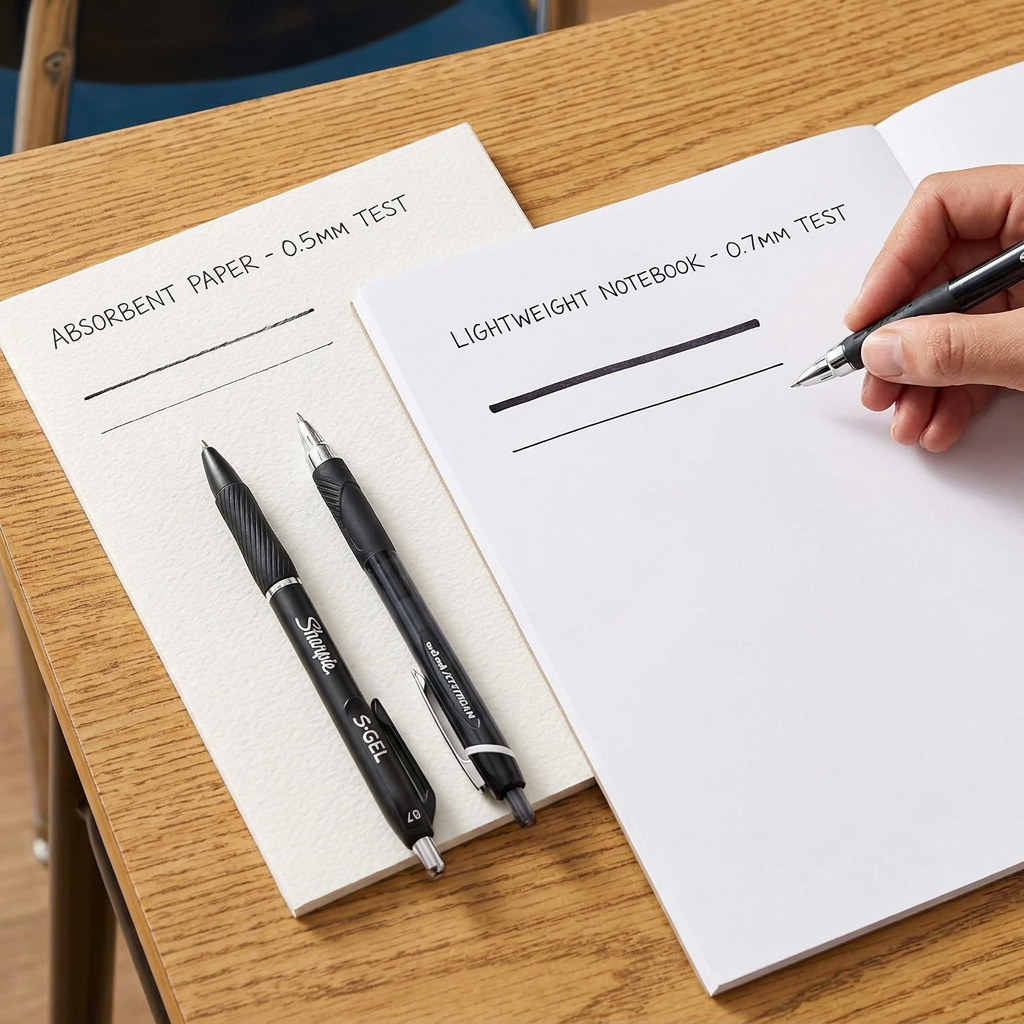
In the liquid gel pen vs ballpoint debate, the same "category" can behave almost opposite just by changing tip size and paper. On lightweight school notebooks, pairing a 0.7 mm tip with a more fluid gel often produces a wider line than you expect, while a 0.7 mm ballpoint more often keeps a crisp edge. Drop to 0.5 mm and the trade-off shifts: gel loses some of the bold "filled" look but becomes easier to manage on absorbent paper; ballpoint gains precision but can feel drier if your pressure gets inconsistent.
The point isn’t obsessing over a number—it’s knowing what the number does in real use. With larger tips (roughly 0.7–1.0 mm), three effects start to matter for note readability:
- Line spread: on porous paper, gel—especially liquid gel—can widen the stroke and make rounded letters look fuller; great for larger handwriting, less ideal for tight lines or small grid paper.
- Visual crowding: in dense paragraphs, a thicker line reduces white space between letters; with compact handwriting, pages can look darker and harder to scan.
- Symbol precision: math symbols, superscripts, arrows, and indices often benefit from 0.5 mm (sometimes even finer), especially if you write fast.
Paper isn’t just "thick or thin." Schools circulate different finishes, from slightly coated photocopies to very absorbent notebooks. Gel and ballpoint react differently on smoother surfaces: gel can sit on top longer before it settles, increasing the smear window; ballpoint often leaves a thinner, drier-feeling film, reducing drag-smear risk, but it can look less saturated if the ball doesn’t get enough traction.
If you switch constantly between notebooks and printed sheets, consistency matters more than peak performance on one surface. A pen that’s amazing on one paper and fussy on another forces you to change pressure, angle, and speed. That’s where "difference" stops being a vibe and becomes ergonomics: constant adaptation is tiring, even if you don’t notice it immediately.
Notes, tests, and forms: where the difference shows up fast
Gel pen vs ballpoint writing changes depending on the school context. For notes, the priority is speed with a continuous line. For tests, the priority becomes cleanliness, legibility, and tolerance for corrections. For forms or worksheets with fixed boxes, the "right" pen is often the one that stays inside boundaries without surprises.
One practical difference between liquid gel and ballpoint is how they handle pauses. During a test you stop, think, and restart. A very fluid gel can leave a darker dot if the tip rests on the page for a moment, while ballpoint tends to "pool" less. That isn’t automatically bad—it can even help if you want to mark a point with minimal pressure—but with small handwriting it can look messy.
On multiple-choice sheets or grids, repeatability matters. Ballpoint often keeps a more consistent stroke width when filling small circles and boxes. Liquid gel feels softer, but if the paper is smooth and your motion is more "brush-like," you can smear edges with a small drag.
For drawing and diagram-heavy subjects, two other differences show up: layering and control. Gel’s saturated line works well for headings, outlines, and light fills. Ballpoint is good for hatching and repeated thin lines without over-darkening the page. If you build concept maps with color coding, gel tends to give stronger contrast; a smooth ballpoint (including hybrids) can stay more discreet and sometimes more readable in tight spaces because it doesn’t widen fine strokes as easily.
Corrections matter too: correction tape/fluid and overwriting. Very fluid gel can struggle on some correction surfaces, while ballpoint often grips more easily. It’s not a universal rule, but you notice it when you’re fixing mistakes quickly.
Drying and highlighters: a simple 3-step check (5–30–120 seconds)
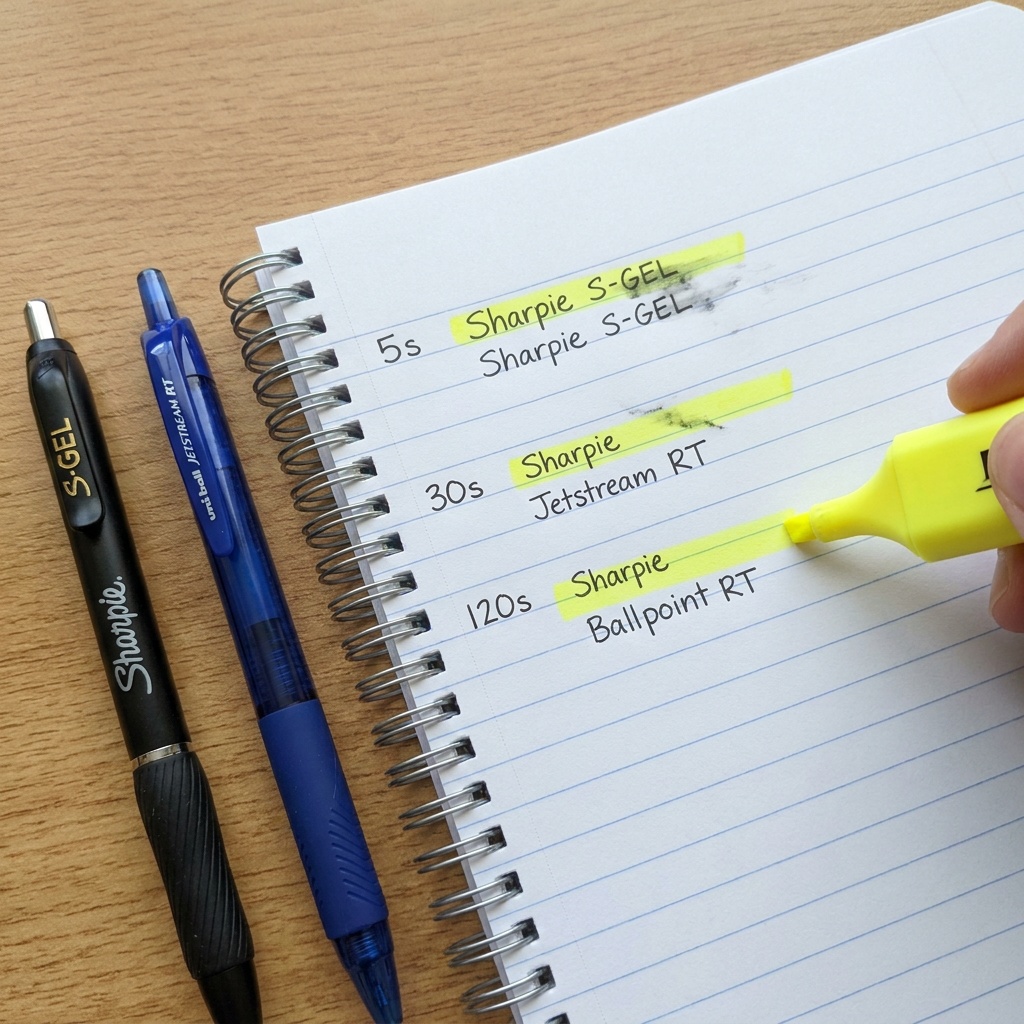
Highlighter compatibility is one of the fastest ways to make the liquid gel pen vs ballpoint comparison measurable. Instead of relying on impressions, observe what happens after three short waits: about 5 seconds, about 30 seconds, and about 120 seconds. You don’t need to time it obsessively—just repeat the same action on real paper (notebook, photocopy, loose-leaf) and see when the result becomes clean.
This check is useful because it isolates a mechanism: how much ink stays mobile on the surface before it settles. Liquid gel, because it’s designed to feel smooth, can be more vulnerable in the first moments—especially with heavy strokes and larger letters. Ballpoint often stabilizes sooner, but it can still smear if the highlighter is very wet or you scrub back and forth over the same spot.
Three typical outcomes help you interpret what you see:
- Visible streaking and a dirty highlighter tip: the ink hasn’t settled yet; with liquid gel this is common at the earliest timing, and it can still happen later on smoother paper.
- A light haze but readable text: the line shifts slightly; often acceptable for personal notes, less ideal for neat diagrams or work you hand in.
- No streak and even color: the drying window matches your study rhythm; at this point gel vs ballpoint becomes much less dramatic.
The same logic applies to turning pages or closing a notebook. If you write densely and then close immediately—or stack papers—an ink that settles quickly is a real advantage. It’s not only about left vs right hand; it’s about pace. A very fluid gel can be perfect for low-pressure writing, but if your routine includes quick highlighting, page turns, and paper stacking, you’ll pay the penalty more often.
Water resistance ties in indirectly: ink that stays mobile longer can also be more reactive to immediate moisture (drops, condensation, slightly wet hands). Without clear manufacturer guidance, it’s sensible to treat very fluid gels as less forgiving in the first moments after writing.
School use beyond writing: what to ask from a pen
A school pen doesn’t live in a lab. It gets dropped, borrowed, left near heat, and crushed in a packed pencil case. In ballpoint vs gel pens, the question isn’t only "how does it write?" but also "how predictable is it in real conditions?"
On the practical side, it helps to ask whether the pen tolerates three common habits: variable pressure, imperfect surfaces (rough desks, bent notebooks), and restarting after pauses. A smooth ballpoint often forgives bumps and long storage better; a very fluid gel can be more sensitive to tiny tip obstructions and small changes in how the ink behaves. That doesn’t mean it "breaks"—it means the experience can be less consistent.
On the materials side, a useful reference point in Europe is REACH (Regulation (EC) No 1907/2006). It isn’t a "pen certification," but a framework that regulates certain chemical substances in products placed on the EU market. For school supplies, the practical takeaway isn’t reading the regulation line by line—it’s checking whether a manufacturer provides clear compliance statements or documentation when required. The official text is available via Regulation (EC) No 1907/2006 (REACH). For a plain-language overview, see the European Chemicals Agency (ECHA) REACH page: https://echa.europa.eu/regulations/reach/understanding-reach.
This helps keep "ink" and "risk" from getting mixed up. In everyday school life, the most common issue isn’t regulatory compliance—it’s usage hygiene: ink on hands, stains on pencil cases, marks on clothing and desks. Here the gel vs ballpoint difference becomes concrete again: saturated gel (especially liquid gel) can transfer more easily if touched right after writing; ballpoint, leaving less ink on the surface, tends to reduce those immediate-contact accidents.
If you want a second category reference, you can check the current product details for Uni-Ball Jetstream RT Pens – Pack of 3 Black Fine Point Pens, 0.7mm on Amazon.
Liquid gel pen vs ballpoint: three choices that matter more than "feel"
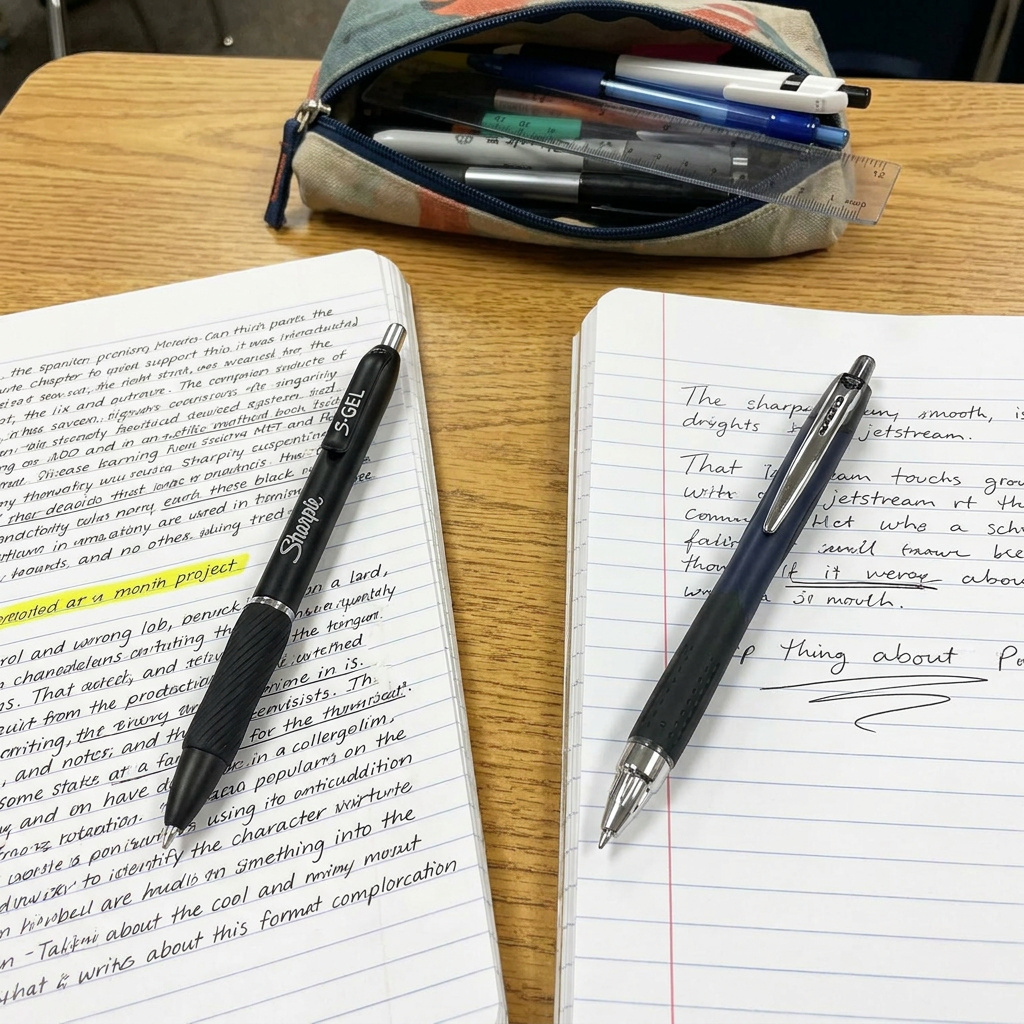
Once you leave theory, the decision gets simpler than people expect: what matters isn’t how much you enjoy smoothness, but how often your study habits create predictable accidents. Three practical choices change everything: how tightly you write (small vs large handwriting), how often you go back over text (highlighters, underlines, arrows), and how rough your pen’s daily life is (packed case, borrowing, being left around).
The most useful framing—without forcing a winner—is this: liquid gel is a comfort-and-saturation choice; ballpoint is a margin-of-error choice. If your goal is a clean page even when you turn pages quickly or fill tight spaces, ballpoint often reduces daily problems. If your goal is to write for a long time without gripping hard, and you want a full line with light pressure, liquid gel usually makes it easier to keep a steady pace.
One detail that gets ignored: day-to-day consistency. During test-heavy weeks, when you bounce between notes, printed sheets, and corrections, a tolerant pen can be more valuable than a "beautiful" one. During long study stretches, smoothness becomes a real ergonomic variable. The best choice is the one that reduces mental adjustments: fewer pressure changes, fewer pauses to wait for ink, fewer side scribbles to restart.
| Typical School Situation | Option That Usually Holds Up Better | Why (And What To Expect) |
|---|---|---|
| Long, fast notes and hand fatigue | Liquid gel | Full line with light pressure; needs more care right after writing |
| Tests, forms, small spaces, tight margins | Ballpoint | Drier, more controlled line; less drag-smear risk while repositioning your hand |
| Backpack use: bumps, temperature swings, borrowing | Ballpoint | Often more predictable over time; can still hard-start, but usually tolerates storage better |
| Diagrams, headings, contrast and color impact | Gel (including liquid gel) | High saturation and immediate legibility; on absorbent paper it may look wider than expected |
When this choice helps (and when it just adds annoyance)
The liquid gel pen vs ballpoint comparison matters most if you alternate between heavy note days and test days: smoother writing helps for long sessions, while a drier line helps when page cleanliness is a requirement. It also makes sense if you write medium-to-large and want a bold line without increasing pressure, or if you build concept maps where visual contrast matters.
It becomes frustrating when your routine is mostly smooth paper, fast page turns, immediate highlighting, and very tight spaces. In those cases, chasing smoothness can add small recurring problems (smears, hand marks, messy edges) that cost time and attention. If you want a pen that behaves "the same" after weeks of being tossed around and borrowed, ballpoint often fits better because it gives you a wider margin for everyday abuse.
Frequently asked questions
In liquid gel pen vs ballpoint, which is safer for keeping notes clean?
If "safer" means fewer smears and fewer surprises when you turn pages or touch the paper, ballpoint is usually more forgiving. Liquid gel can produce very readable pages, but it asks you to manage the first moments after writing.
Do left-handed students need to avoid liquid gel?
No, but it depends on grip and pace. If your hand regularly passes over fresh writing, the chance of smudging goes up. In that case, ballpoint reduces risk, or you can use gel with more deliberate pauses and a stronger page rotation.
Why does a pen sometimes skip only in certain spots on the page?
It’s often not one single defect. Your writing angle changes, pressure changes, and the surface changes (creases, smoother zones, dust, paper fibers). Ballpoint can react to small traction changes; gel can react to tiny tip obstructions and how the ink sits on the surface.
How much does tip size really matter in ballpoint vs gel?
It matters most when your page is dense. Larger tips make lines more visible but reduce white space between letters, especially with small handwriting. As a general school compromise, 0.7 mm is common; 0.5 mm often favors precision and control in tight lines.
Is water resistance a reliable way to choose?
Not as a single deciding factor. Ink behavior depends on the specific formulation, and two pens in the same broad family can behave differently. If your goal is to reduce damage from moisture in a backpack, a drier line is often a safer starting point, and it’s worth observing how your ink reacts to immediate humidity.
Three things worth remembering
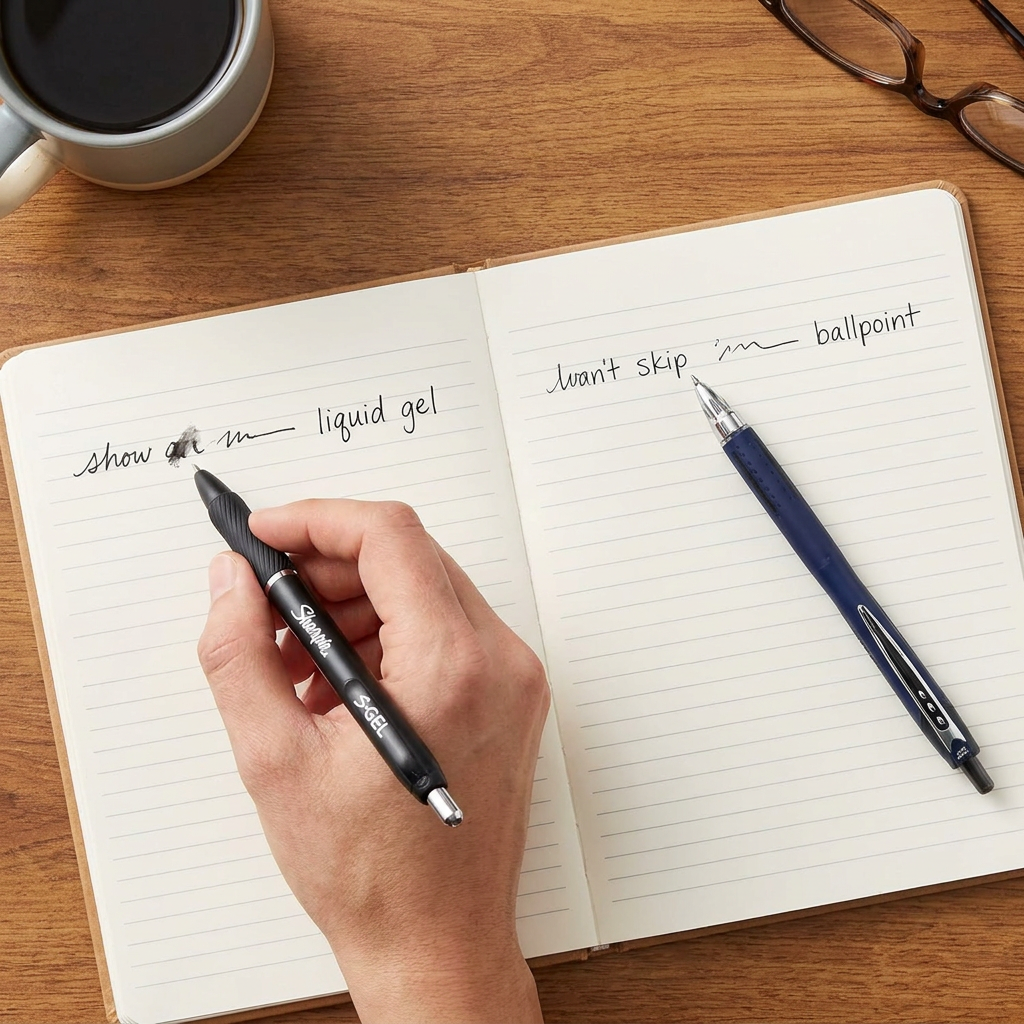
In liquid gel pen vs ballpoint, the best choice is the one that reduces your repeat mistakes: smearing and timing, or skipping and pressure.
The trade-off isn’t "soft vs hard," but comfort vs margin of error: liquid gel rewards long writing sessions, ballpoint rewards cleanliness and predictability.
If your pages must stay neat in real conditions (smooth sheets, quick highlighting, backpack life), everyday tolerance often matters more than perceived smoothness.