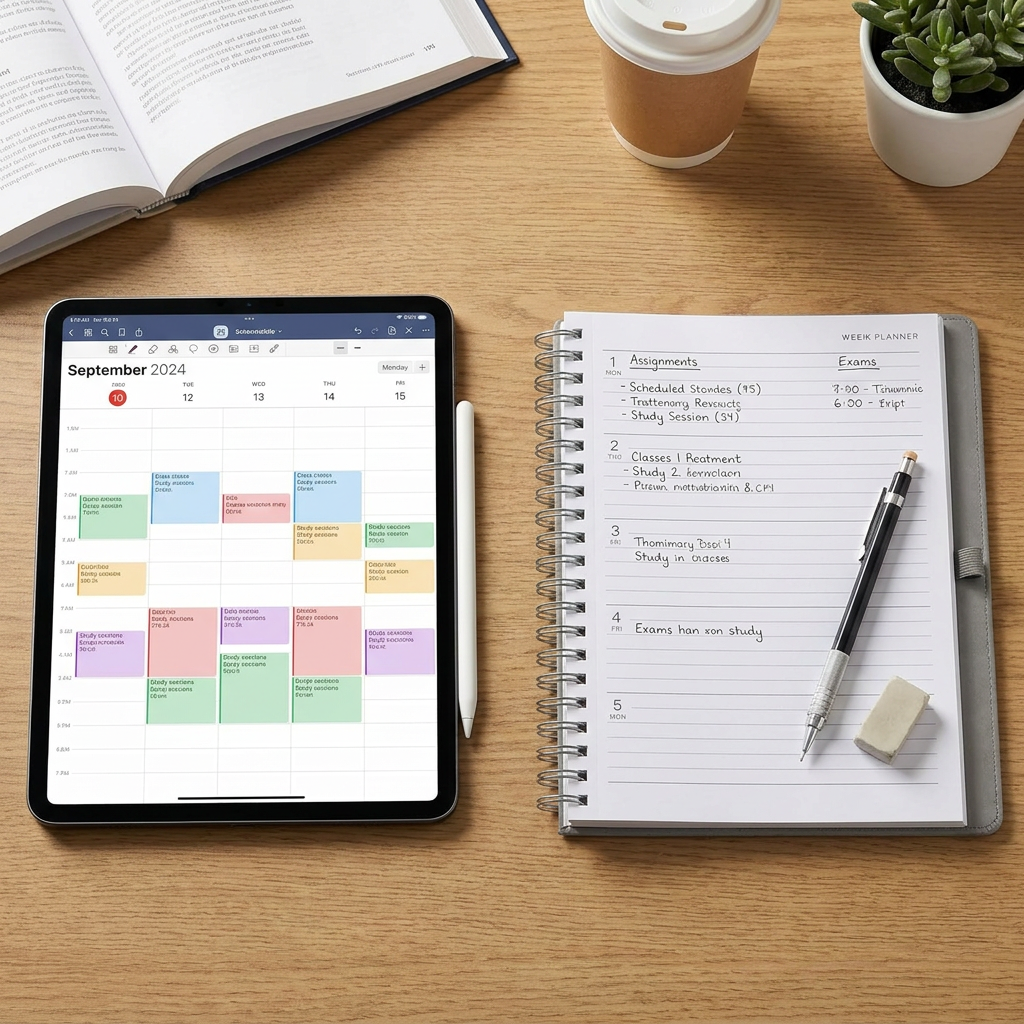
A planner tracks dated deadlines and time; a notebook holds freeform notes. Most students use both to stay on top of schoolwork.
In the planner vs notebook decision, the real split isn’t "organized vs messy." It’s structure vs space. A planner gives a fixed place for deadlines, recurring classes, and week-by-week planning. A notebook gives room for lectures, problem sets, diagrams, and the messy middle of learning.
For school, the choice shows up fast in three moments: when a teacher announces a due date, when a lecture moves too quickly to rewrite neatly, and when multiple classes collide in the same week.
- Choose a planner when deadlines and time blocks keep slipping, even if notes are fine.
- Choose a notebook when the main pain is capturing and reviewing content, not scheduling.
- Use a hybrid when classes, labs, sports, and work create weekly conflicts that need both planning and note space.
Planner or notebook for students: the practical difference
A planner is a calendar system in paper form. It works because the page already tells the brain where to put a date, a task, and a time. Weekly spreads and monthly grids create a "default home" for assignments and exams. That structure is the point.
A notebook is a capture system. The page doesn’t decide anything. It simply holds information in the order it arrives: lecture notes, reading notes, worked examples, sketches, and quick reminders. A notebook can be organized, but it won’t force organization.
That difference matters in school because teachers speak in dates and students study in sessions. A planner translates "due Friday" into a visible week. A notebook translates "here’s the concept" into something reviewable later.
Two quick checks keep the planner vs notebook question grounded:
- If missed work is the recurring issue, a dated layout usually helps more than a new note format.
- If studying feels inefficient, better notes and review structure usually matter more than a stricter calendar.
Why the planner vs notebook choice feels harder than it should
School creates a strange mix of predictable and unpredictable. Class times repeat, but assignments don’t. Some weeks stay calm, then two tests land on the same day.
Planners handle predictable cycles well. They struggle when the student needs extra space for messy projects, lab logs, or long problem sets. Notebooks handle messy learning well. They struggle when the student needs a single, reliable place to see every deadline across every class.
Another reason it feels tricky: students often try to make one tool do everything. That can work, but only if the format supports it. A single notebook can carry notes and planning, yet it needs an indexing habit. A single planner can hold notes, yet most planner pages run out of space during real lectures.
And there’s a quiet logistical issue. A semester is long. Paper has limits. A notebook that’s too thin fills up before finals. A planner that’s too bulky stays at home, then deadlines vanish from view.
So the comparison isn’t philosophical. It’s physical and behavioral. Page space, portability, and the student’s tolerance for keeping categories separate decide most outcomes.
The school criteria that actually decide planner vs notebook
Most advice stops at "planners are for schedules, notebooks are for notes." That’s true, but it doesn’t help at the store shelf. The useful criteria are the ones that change daily friction during a school week.
Page structure: dated vs open pages
Weekly and daily layouts reduce decision fatigue. But they also lock the student into a pace. If a week gets skipped, empty pages can feel like failure. Undated planners avoid that. Notebooks never punish gaps, but they require a separate system for dates and deadlines.
Size: portability vs writing space
Common school-friendly sizes cluster around A5 (about 5.8 x 8.3 inches), B5 (about 6.9 x 9.8 inches), and US Letter (8.5 x 11 inches). Smaller sizes travel well. Larger pages handle diagrams, math steps, and wide margins for corrections. This decision often flips when the student uses lots of graphs, chemistry structures, or long equations.
Binding: how it behaves on a desk
Spiral binding lies flat and folds back, useful in cramped lecture halls. Sewn or perfect binding stacks neatly in a backpack and can feel sturdier, but it may not stay open without pressure. Disc-bound systems allow rearranging pages, which can reduce chaos in multi-class notebooks, but discs can catch on bag fabric.
Paper weight (gsm): pens, highlighters, and bleed-through
School supplies vary. Gel pens and felt-tip markers can ghost or bleed on thin paper. Paper around 70–90 gsm is common in student notebooks and works fine with pencils and basic ballpoints. Paper around 100–120 gsm handles heavier ink and highlighting more cleanly, but it adds bulk and cost. For many students, the "right" choice is the one that matches the tools already used every day.
Page count and replacement rhythm
A single-subject notebook can fill in weeks if notes are detailed. Multi-subject notebooks reduce the number of items carried but can become hard to review. Planners run on a fixed timeline. That’s helpful. It also means the student is committing to a full term or year format, even if their schedule changes midstream.
Context switching: how many times the brain changes gears
Students lose time when they jump between places: one app for dates, a notebook for notes, loose paper for handouts, and sticky notes for reminders. A planner can reduce that if it becomes the default for deadlines. A notebook can reduce it if it becomes the default for everything learned. The best system is the one that cuts the number of places to check before starting work.
Weekly view, daily pages, or open notes: how layouts change school behavior
Layout is the quiet driver in the planner vs notebook choice. It changes what gets written down, when it gets checked, and how much rewriting happens during a week.
A weekly planner spread compresses reality. It forces every class, shift, and deadline into a limited rectangle. That constraint helps when assignments get forgotten, because the week becomes a single dashboard. But it can also hide the true size of a project. A research paper that needs five study sessions looks small when it’s squeezed into one line on Tuesday.
Daily planner pages do the opposite. They give room for step-by-step tasks, but they can fragment multi-class thinking. A student can end up living "inside today" and not noticing that two tests land five days apart. For heavy course loads, daily pages also create a practical issue: some planners run out of dated space before the term ends if they’re designed for a shorter cycle.
Notebooks sidestep both problems, but they introduce a different one: time is not built into the page. A date written at the top of a page is easy to skip when flipping back for review. That’s not laziness. It’s a design reality.
In school settings, three layout details tend to matter more than brand names:
- How many "slots" exist per day: if a planner has only a few lines per day, it favors short homework tasks over long study blocks.
- Whether the monthly grid is usable: small boxes can’t hold real due dates plus reminders. Students then stop checking the month.
- Whether note space is integrated: when notes pages sit far from the calendar pages, deadlines and notes drift apart again.
Even within notebooks, the page pattern changes behavior. Wide-ruled lines can feel fast for lecture capture. Dot grid pages support diagrams and math corrections without the visual noise of full graph paper. Blank pages work for art and physics sketches, but they punish students who need alignment for equations.
Small layout mismatches create big friction. That’s why the planner vs notebook question often turns into a layout question after the first week of classes.
Tools and paper compatibility: pens, highlighters, and why gsm isn’t just a hobby detail
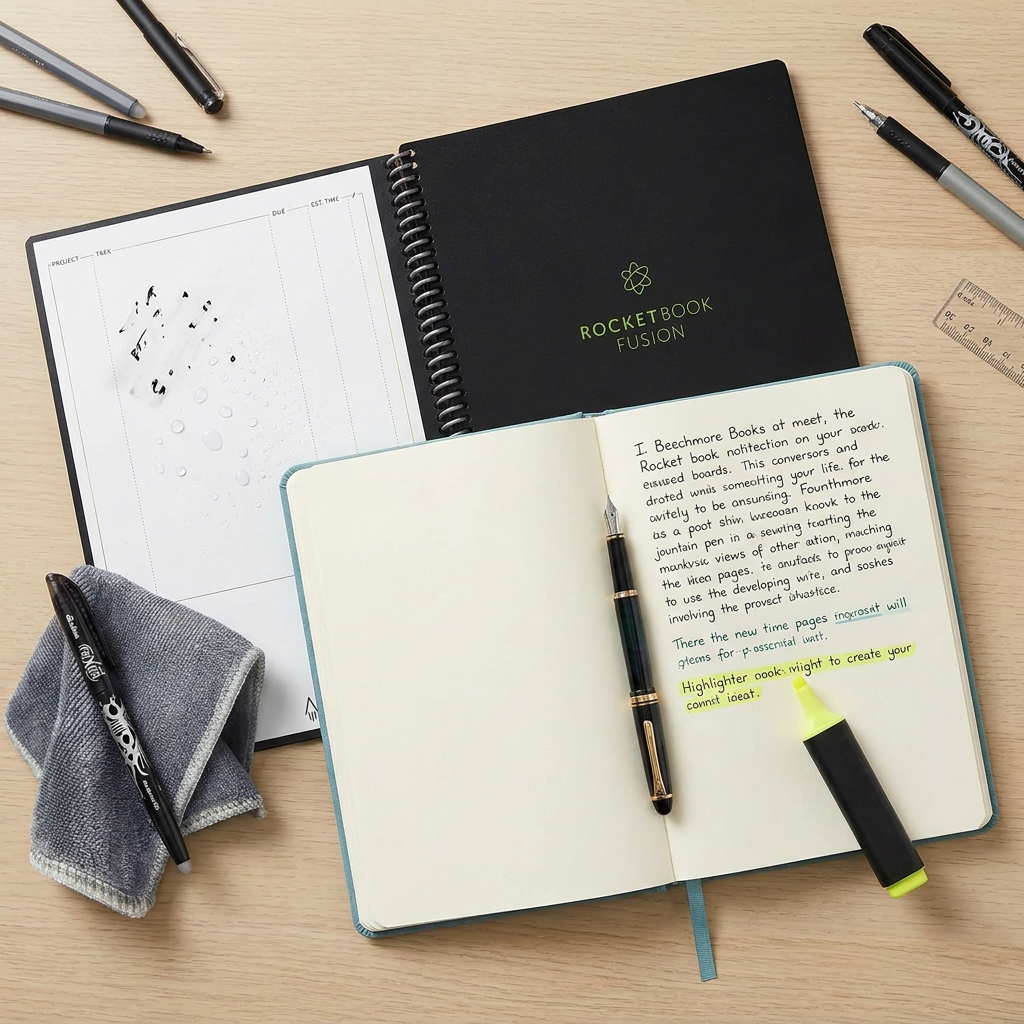
Paper weight is easy to ignore until a study session turns into a smudged, gray mess. In this setup, paper behavior matters because planning often uses quick marks and highlighting, while note-taking can involve dense ink and repeated reviewing.
Many student notebooks sit around 70–90 gsm. That range is fine for pencil and basic ballpoint pens. It becomes less forgiving with gel pens, rollerballs, and felt-tip markers. Bleed-through can make the back side of the page unusable, and even "ghosting" (seeing the writing through the page) can distract during review.
Heavier paper, around 100–120 gsm, usually handles ink and highlighting more cleanly. The trade is bulk. A thicker notebook fills a backpack faster, and the same page count weighs more. For students carrying multiple classes’ materials, that trade is not abstract.
Planners add another layer. A weekly spread often gets edited. Tasks move. Deadlines change. If the paper doesn’t like erasing or correction tape, the page starts to look chaotic by midterm. Some students solve that by writing only in pencil, but pencil fades under heavy highlighting and repeated handling.
Ink choice also changes how portable the system is. If notes rely on wet ink that takes time to dry, quick page turns during lecture cause smears. That’s a notebook problem first, but it shows up in planners too when students write fast in narrow columns.
For paper-based systems, a fast compatibility check saves regret:
- Test the pen and the highlighter on the same page. Some combinations smear even when neither bleeds.
- Check the back side of the page under normal light, not a phone flashlight. Real study happens under classroom lighting.
- Decide if rewriting is part of the method. If rewriting happens weekly, paper that stays clean under edits matters more than paper that looks fancy.
Paper isn’t only about aesthetics. It decides whether the notebook stays readable in November.
Reusable and scannable systems: when Rocketbook Fusion changes the planner vs notebook trade-off
Reusable formats shift the planner vs notebook comparison because they change the cost of mistakes. A traditional planner makes skipped weeks visible forever. A standard notebook keeps every rough draft, even when it becomes noise.
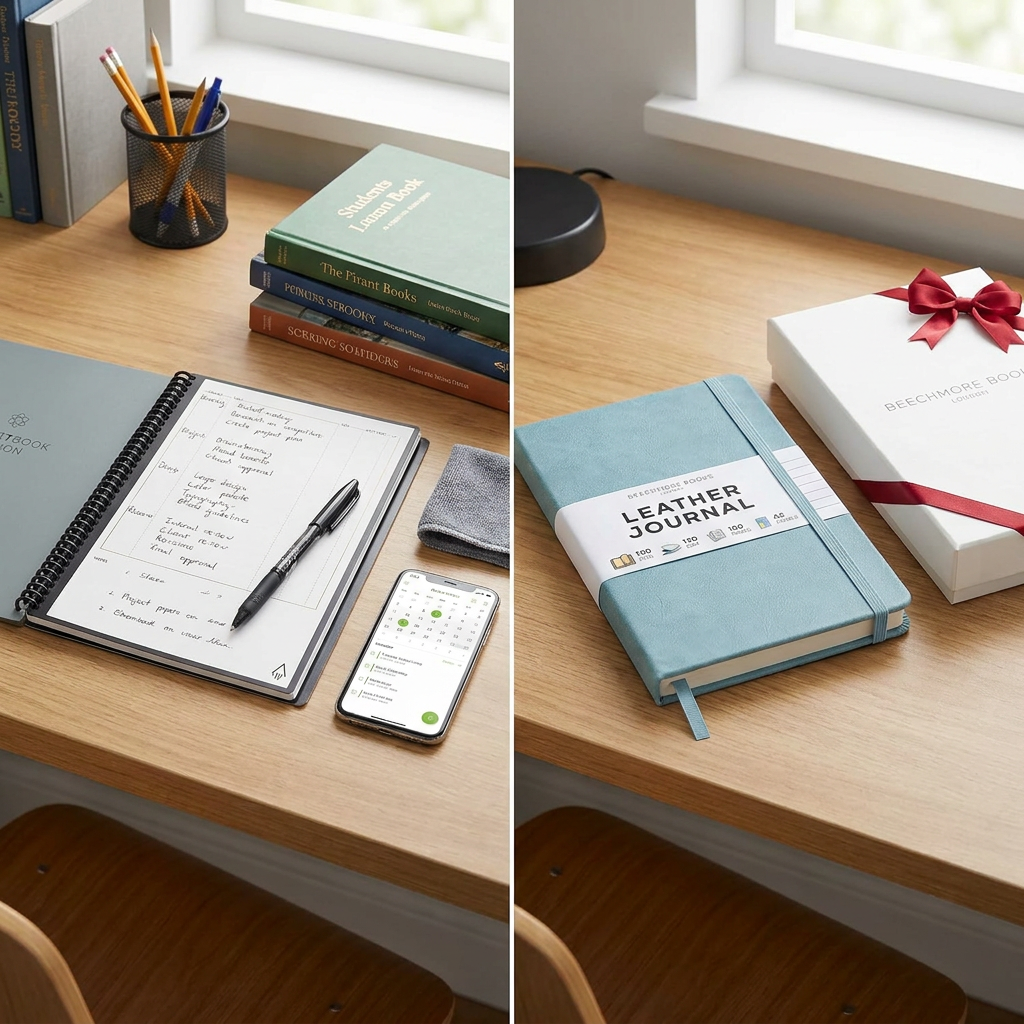
Rocketbook Fusion Reusable Undated Productivity Planner is built around that idea. It blends planning pages (monthly and weekly) with extra note pages, and it’s undated. That matters in school. An undated layout tolerates irregular weeks, like exam periods or school breaks, without leaving a trail of empty dated pages.
The size is US Letter, 8.5 x 11 inches. That’s generous for writing space and for multi-step tasks. It’s also less comfortable for on-the-go planning in crowded hallways, and it takes up more backpack real estate than an A5 notebook.
Reusable pages also change writing tool constraints. Systems like this typically require compatible erasable pens. In practice, that can be a good boundary. It prevents the "random pen" problem that creates inconsistent ink and smearing. But it also means the student must keep the right pen available every day.
Scanning is the other hinge. A reusable planner can act like a bridge between paper and digital storage. Notes can be captured and filed by class folder, then erased from the page. That reduces physical bulk over a semester. It also introduces a new habit: scanning has to happen reliably, or information disappears when pages get reused.
So Rocketbook Fusion doesn’t replace the planner or the notebook category outright. It shifts the failure modes. Instead of "ran out of pages," the risk becomes "forgot to digitize before erasing." For students already comfortable with keeping class materials in Google Drive, OneDrive, or similar systems, that trade can be easier to manage. For students who want paper to be the final record, it can feel fragile.
For more on safe cloud storage and sharing basics in education settings, see the U.S. Department of Education guidance: https://studentprivacy.ed.gov/.
When a notebook like BEECHMORE BOOKS fits school work, and when it starts to fight the schedule
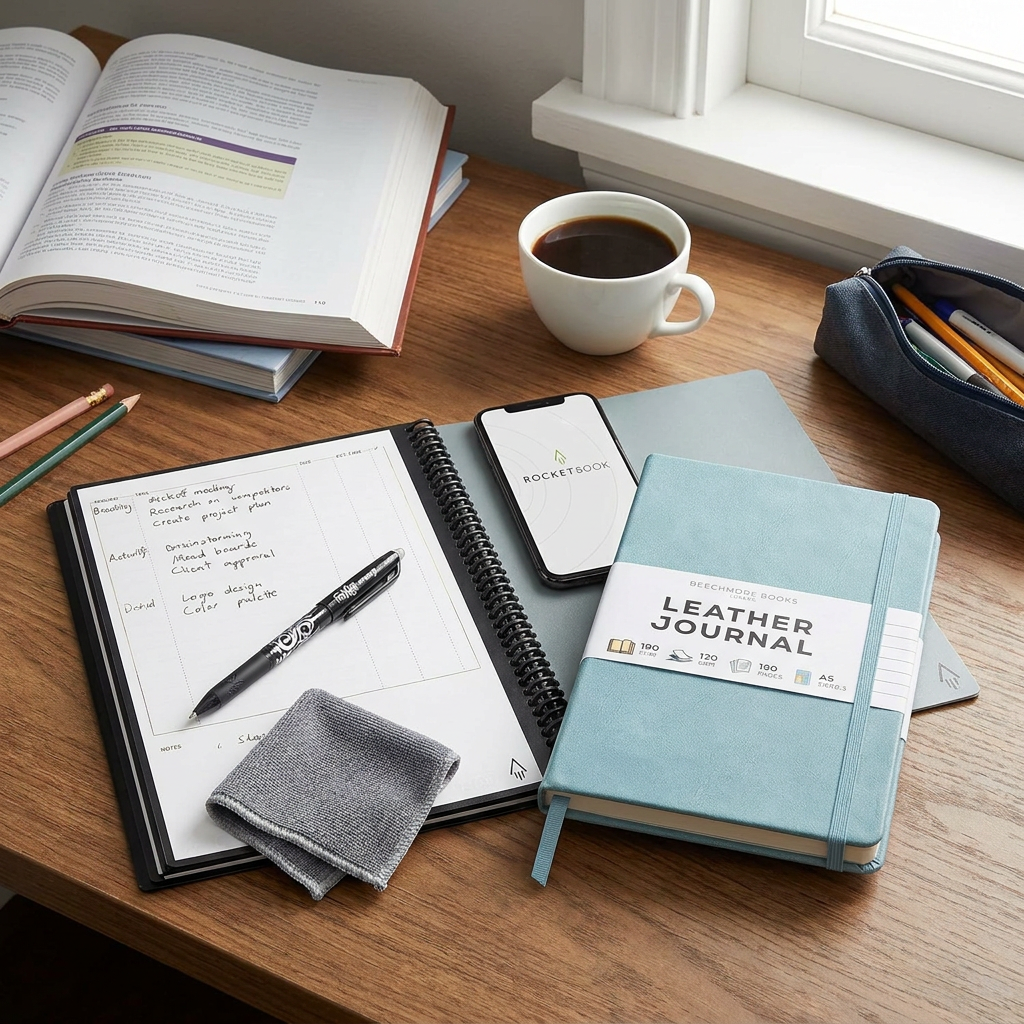
A classic notebook approach still wins in many classrooms because it’s frictionless. Open the page. Write. No special tools. No scanning step. That simplicity is a real performance feature when lectures move quickly.
BEECHMORE BOOKS Premium Lined Leather Journal is closer to a "single, durable notebook" strategy than to a planner strategy. It’s A5 (5 x 8 inches), so it travels easily. The paper is listed at 120 gsm, which tends to handle ink and highlighting with less bleed-through than lighter student notebooks. That spec matters if the student uses gel pens or layers color during review.
But a lined journal format has limits in school contexts. Lined pages are fast for text-heavy classes. They’re slower for math, chemistry structures, and diagrams that need alignment. Students can still do that work on lined paper, but corrections and spacing get messy quickly.
The bigger limitation is not the cover or the paper. It’s time visibility. A notebook like this can hold an assignment list on the first pages, or a running calendar at the front. It can also hold weekly plans. Yet it only works when the student is consistent about updating those pages, and about flipping back to them.
That’s where the planner vs notebook tension shows up. A notebook can become a full system, but it demands a manual rhythm:
- Write dates clearly at the top of entries and use the same format every time.
- Reserve a fixed section for deadlines so they don’t get buried under lecture notes.
- Use a simple index on the first pages, or at least consistent class headers, so review doesn’t turn into page hunting.
Without that rhythm, the notebook stays excellent for learning content and weak for keeping a multi-class schedule under control. With it, a single A5 notebook can carry a surprising amount of school life, especially for students with fewer timed commitments outside class.
How to avoid duplicate work when using both a planner and a notebook
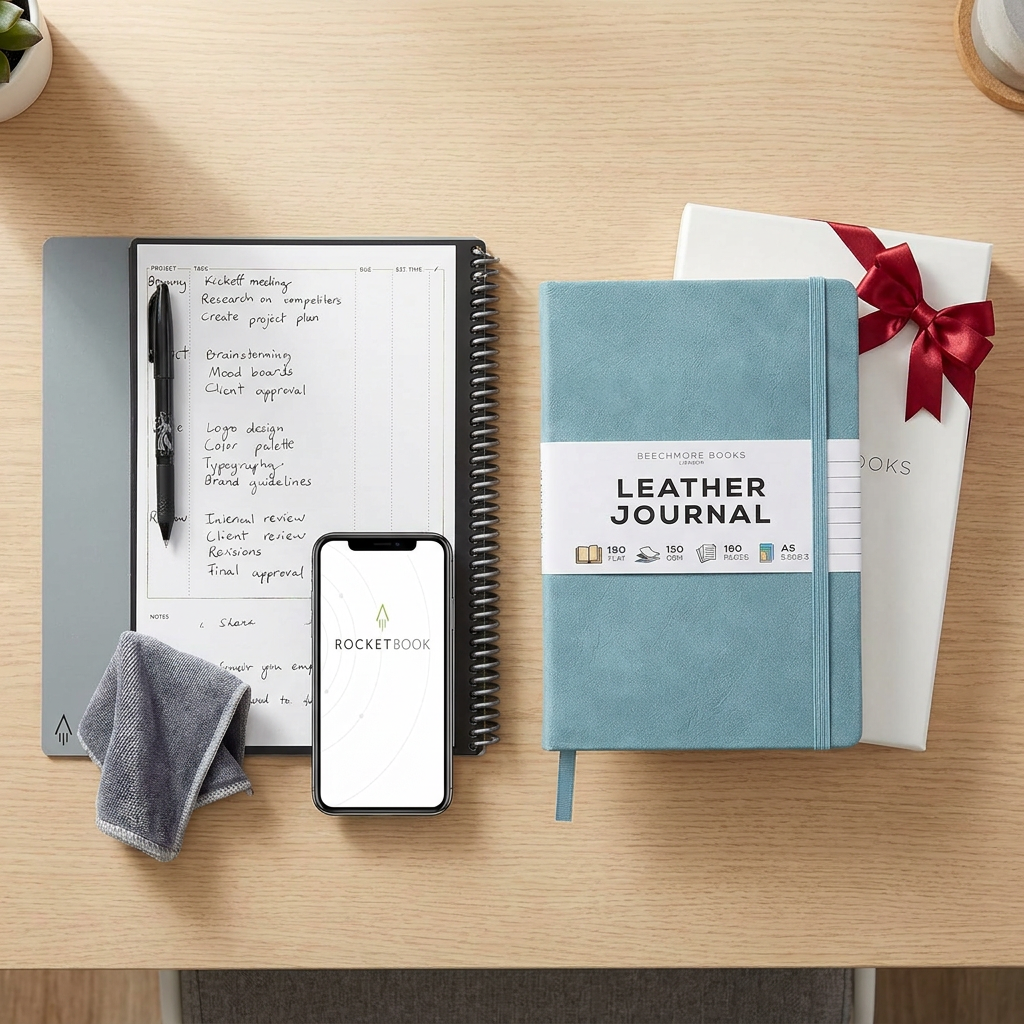
Most student systems fail in a boring way. The same assignment gets written in three places, then updated in only one of them. After two weeks, nothing matches and the system stops getting checked.
A clean planner vs notebook setup needs a single "source of truth" for deadlines. Put every due date and test date in one place only. The other tool can reference it, but shouldn’t try to mirror it line for line. That one decision removes the constant rewriting that makes planning feel like homework.
For school, the lowest-friction split is usually simple: the planner holds dates and next actions, the notebook holds learning. Keep the handoff lightweight. When a teacher announces "quiz next Thursday," it goes straight into the planner. If a lecture ends with "do problems 1–20," that becomes a short task in the planner, while the worked steps and corrections live in the notebook.
Two small habits keep the tools linked without turning them into duplicates:
- Use a stable class code (like MATH, BIO, ENG) and write it the same way in both places, so scanning a week shows what belongs to which class.
- Use page pointers instead of rewriting: "BIO notes p. 34" in the planner is enough. The notebook doesn’t need the whole deadline repeated.
And keep the weekly reset short. Ten minutes once a week beats thirty minutes every night. A quick check of the planner’s next seven days, plus a bookmark in the notebook at the current week’s notes, is usually enough to stop the system from drifting.
Two school setups that reduce friction in the planner vs notebook decision
Some students want one carry item. Others want separation by function. Both can work, but only if the setup matches the day-to-day constraints of school: moving classrooms, short passing periods, and sudden changes to due dates.
Setup A: "planner stays clean, notebook stays messy." Planning pages stay readable and mostly unedited. Notes can be fast, imperfect, and dense. This setup fits classes with heavy lecture pace or problem-solving, where rewriting notes is unrealistic. It also fits students who study by revisiting raw notes and adding corrections in the margins, not by creating a second "pretty" version.
Setup B: "notes first, planning in the margins." The notebook is the main object, and planning is a small, protected section inside it (first 10–20 pages, or a back section). This works when the schedule is simple and the bigger struggle is capturing content and reviewing it. But it requires a hard rule: deadlines must be visible on a single page that gets checked daily, not scattered across random dated headers.
Both setups break down in predictable places. Setup A breaks when the planner becomes a second notebook and fills with lecture fragments. Setup B breaks when multiple classes stack deadlines in the same week and the notebook’s planning section isn’t checked under stress.
For students who want a reusable bridge between planning and notes, Rocketbook Fusion Reusable Undated Productivity Planner can support Setup A because planning pages and notes pages sit in one book without forcing everything into the same space.
For students who want a durable, single-notebook routine and can maintain a small planning section consistently, BEECHMORE BOOKS Premium Lined Leather Journal aligns more naturally with Setup B, as long as dates don’t get buried under daily notes.
Planner vs notebook comparison table for school scenarios
| School Scenario | Pick | Why It Works |
|---|---|---|
| Deadlines keep getting missed across multiple classes | Planner (Weekly or Monthly + Weekly) | Dated pages keep due dates visible in one place. |
| Lectures move fast and notes are the main struggle | Notebook | Open pages capture information without running out of "planner space." |
| Math, chemistry, diagrams, or graphs show up daily | Notebook (B5 or US Letter) | More writing room helps with alignment and corrections. |
| Schedule changes a lot (sports, work shifts, rotating labs) | Planner With Daily Pages or Undated Layout | More space for time blocks and edits. |
| You want one book and you’ll scan notes to the cloud | Rocketbook Fusion Reusable Undated Productivity Planner | Planning + notes in one place, with reuse after scanning. |
| You want one durable notebook and a simple schedule | BEECHMORE BOOKS Premium Lined Leather Journal | Portable A5 size and heavier paper, but planning needs a consistent front section. |
Where this fits for school life, and where it doesn’t
This approach fits students juggling 4–7 classes, clubs, work shifts, or labs, where a weekly view prevents deadline collisions and a separate note space keeps lecture capture fast. It also fits anyone who studies in blocks (45–90 minutes) and needs planning pages to protect those blocks from getting eaten by "quick tasks."
It won’t fit students who refuse to check a planner daily, or who keep changing systems every two weeks. It also tends to fail for students who need every class in one continuous notebook but also need strict time-blocking. That combination creates constant rewriting unless the system is simplified down to one deadline list and one running notes section.
Frequently asked questions
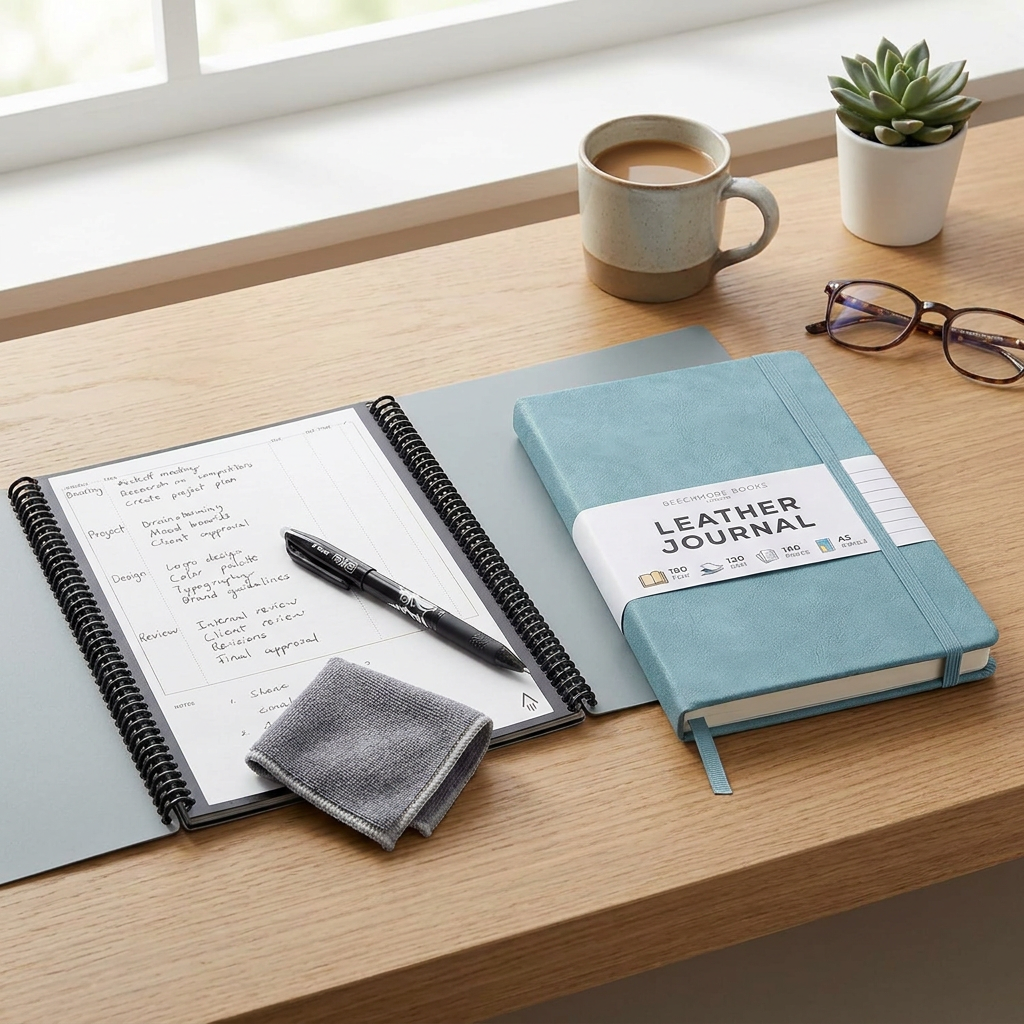
In "Planner vs Notebook," what should be checked daily?
Check the planner daily, even if it’s only for 60 seconds. The notebook gets checked when studying starts, not as a daily ritual. Daily planning is about preventing missed deadlines, not rereading notes.
Is a weekly planner enough for school, or are daily pages necessary?
A weekly layout is enough when the main risk is forgetting due dates and tests. Daily pages help when tasks need sequencing across a day, like labs, sports, and study blocks. If the day plan changes constantly, daily pages can become cluttered unless the system stays minimal.
Can one notebook replace a planner without becoming chaotic?
Yes, but only with a protected deadline section that gets checked every day. Dates written only at the top of notes pages don’t stay visible under pressure. A single page for "this week’s deadlines" usually makes the difference.
What’s the simplest way to handle multiple classes without color-coding everything?
Use short class labels and consistent headers, not a big color system. A two- or three-letter code plus a date is enough for most review and search. Save color for one job only, like marking tests and major due dates.
Three things worth remembering about planner vs notebook
A planner vs notebook choice becomes easy when one tool owns deadlines and the other owns learning notes.
Systems fail more from duplication than from the "wrong" layout.
The right setup is the one that still gets checked during the busiest week of the term.